
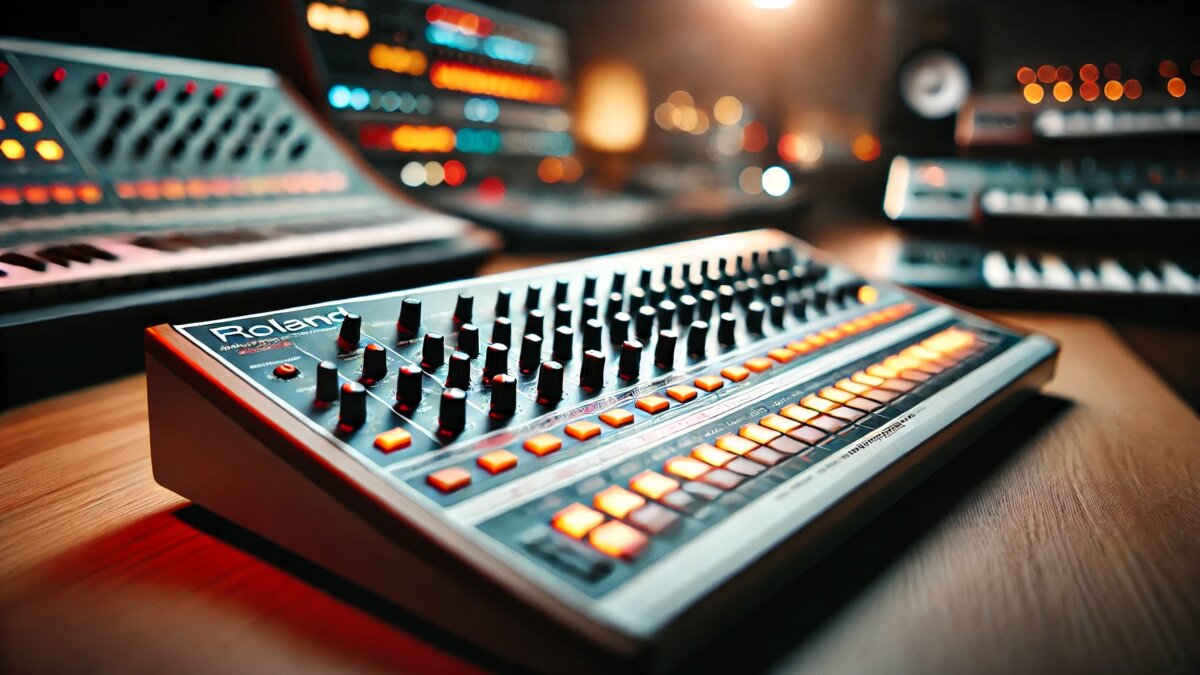
The Roland TR-909 and its clones: A comprehensive guide
The Roland TR-909, affectionately referred to simply as ‘909’, is one of the most iconic drum machines in the history of music. It has shaped the sound of electronic music, especially house and techno, and remains a sought-after tool for producers and artists. In this blog post, we dive deep into the world of TR-909, from its origins to its technical specifications to the best clones and replicas. In addition, we present some typical settings and beats that define the unique sound of the 909.
The History of the Roland TR-909
The Roland TR-909 Rhythm Composer was released by Roland in 1983 and is known for its unique ‘punchy’ sound. It was the first drum machine to combine analog and digital sound generation. The bass drum, snare, toms and rimshot were created analogously, while the hi-hats and cymbals were played as 6-bit samples. This hybrid design gives the TR-909 its distinctive sound that sets it apart from other drum machines of its time.
Originally, the TR-909 was not a great success. Their sound was considered too artificial, and it was taken off the market after only about a year. But in the late 1980s and early 1990s, aspiring house and techno producers discovered the unique charm of the TR-909. From then on, its popularity rapidly increased, and it became a central part of the sound of this genre.
Sound characteristics and technical specifications of the TR-909
The Roland TR-909 is known for its powerful bass drums, crisp snares and characteristic hi-hats. These sounds are to a large extent the result of their analog and digital hybrid structure. The built-in 16-step sequencer allows musicians to create complex rhythms and patterns that are perfect for dance music. Here is an overview of the most important sounds and their typical settings:
- Bass drum (BD): The bass drum of the 909 is known for its powerful and assertive beats. It is often the dominant sound in a mix and has been widely used in house and techno tracks. Typical settings include a decay value between 9 and 12 o'clock and a level of about 3 o'clock.
- Snare Drum (SD): The snare of the 909 has a crisp, metallic timbre. Typical settings include a high tone value and a medium level. The snare is often used together with the rimshot to create more complex percussion patterns.
- Hi-Hats (HH): The TR-909 hi-hats, both open and closed, are digitally sampled sounds and offer a characteristic ‘crispy’ timbre. They are often used in offbeat patterns to promote rhythm.
- Cymbals and Claps: The Clap is one of the most popular sounds of the 909 and is often used in house music. It has a broad, ‘clapping’ sound that occupies a lot of space in a mix.
Classic tracks that made the TR-909 famous
The TR-909 has been used in many iconic tracks that have shaped the sound of electronic music of the late 80s and early 90s. Here are some notable examples:
- Jeff Mills – The Bells: A techno classic that uses the TR-909 to perfection. The driving bass drum and sharp hi-hats are perfect examples of the 909 sound.
- Daft Punk – ‘Revolution 909’: This track is a tribute to the drum machine that is included in the name. The use of the 909 for the Kickdrum and the Claps in combination with clever filter effects makes this track a timeless classic.
- Frankie Knuckles – Baby Wants to Ride: A house classic where the TR-909 was used to create the driving rhythm. The hi-hats and claps of the 909 come into their own here.

The best TR-909 clones and replicas
Since the original TR-909 is rare and expensive today, many manufacturers have tried to create their own version of the 909. These clones are available both as hardware and as software. Below you will find an overview of the best and most popular replicas:
1. Hardware clones
Behringer RD-9
The Behringer RD-9 is a modern analog replica of the TR-909 and one of the most popular clones on the market. It uses analog circuitry to reproduce the sound of the original 909, and offers some additional features that improve usability.
- description: The RD-9 has recreated the analog circuitry of the original and offers additional modern features such as advanced step-sequencing options, effects, and improved MIDI integration.
- specifics: Switchable mode for "Vintage" and "Enhanced" sounds, built-in filters and wave designers that allow additional creative sound editing.
- price: Significantly cheaper than an original TR-909; Usually between 300 and 400 euros.
- Typical settings: For the classic 909 sound, the ‘vintage’ setting is often used, with the bass drum and snare slightly compressed and provided with additional decay to create more punch.
Roland TR-09
The Roland TR-09 is a digital replica of the original that is part of the Roland Boutique series. It uses Analog Circuit Behavior (ACB) technology to reproduce the sound of the TR-909 as authentically as possible.
- description: The TR-09 is compact and portable, ideal for live performances and smaller studios.
- specifics: The TR-09 has all the controls of the original TR-909, but is much smaller and offers USB and MIDI connectivity.
- price: About 350 to 500 euros on the second-hand market.
- Typical settings: Attitudes are strongly based on the original; Typically, bass drum and snare are kept at mean decay values to produce the typical 909 groove.
Acidlab Miami
The Acidlab Miami combines the sound of the TR-808 and TR-909 in an analog drum machine. It offers an intuitive 16-step sequencer and excellent analog sound generation.
- description: Analog sound generation, step sequencers, and high quality standards for analog circuits.
- specifics: It allows you to mix the typical sounds of the 808 and 909 to create versatile rhythm patterns.
- price: It is in the range of 800 to 1,000 euros.
- Typical settings: Often the hi-hats of the 909 are combined with the bass drums and claps of the 808 to create a unique sound.
Yocto 2 (e-licktronic)
Yocto 2 is a DIY kit from e-licktronic, which is an analog replica of the TR-808 and TR-909. It is a very accurate replica with true-to-original sounds.
- description: Analog circuits, DIY kit, very true to the original sound. However, the kits require soldering experience.
- specifics: This DIY kit allows enthusiasts to build and modify their own drum machine.
- price: The kit costs around 450 to 600 euros, depending on availability and any additional components needed.
- Typical settings: Since it is a DIY kit, the sounds can be fully customized. Typical settings can be very close to the original or heavily modified, depending on your preferences.
MFB Dance Bear 2
The MFB Tanzbär 2 is not a direct clone of the TR-909, but a drum machine that offers sounds in the style of the 909 (as well as the 808). It offers a mix of analog and digital sounds as well as extensive modulation options.
- description: Polyphonic sequencing capabilities, analog-digital hybrid architecture, many customization options.
- specifics: It offers extensive modulation options and flexible sound design.
- price: Between 700 and 900 euros.
- Typical settings: By combining analog and digital sounds, classic 909 sounds or completely new creations can be created.
2. Software clones and plugins
Roland Cloud TR-909
The Roland Cloud TR-909 plugin is an official emulation
Roland's TR-909 and also uses ACB technology to faithfully replicate the sound.
- description: An official software plugin from Roland that is part of the Roland Cloud subscription service.
- specifics: Authentic sound emulation by ACB, integrated into many DAWs (Digital Audio Workstations), regular updates and support by Roland.
- price: As part of the Roland Cloud subscription, which is paid monthly or annually.
- Typical settings: This plugin offers the possibility to recreate classic settings of the 909 simply with a mouse click. The authentic bass drum and snare combinations for house and techno tracks are popular.
D16 Group Drumazon
Drumazon from the D16 Group is a VST plugin that reproduces the sound of the TR-909 in great detail. It offers advanced features and modifications that go beyond the original.
- description: A software plugin that provides a detailed emulation of the TR-909.
- specifics: Complete control over all drum sounds, additional features such as overdrive and effects, step sequencer.
- price: About 100 to 150 euros.
- Typical settings: Many producers use Drumazon to produce particularly ‘fat’ kicks and crisp snares. A popular setting is a highly compressed bass drum with a long decay time.
AudioRealism ADM (AudioRealism Drum Machine)
A versatile plugin that mimics several classic drum machines including the TR-909. It offers flexible processing options and is well integrated into many DAWs.
- description: A plugin that mimics multiple drum machines.
- specifics: Imitation of various drum machines (808, 909, etc.), intuitive user interface, low CPU consumption.
- price: Between 80 and 120 euros.
- Typical settings: The flexible user interface allows you to easily modify or extend the classic 909 sounds.
Native Instruments Battery and Machine Expansion Packs
While Battery 4 from Native Instruments offers a variety of drum sounds, there are specialized expansion packs for the machine series that focus the TR-909 sound.
- description: Large sound archive, expandable sound libraries, seamless integration with NI machine hardware.
- specifics: Native Instruments offers a wide range of ways to modify and customize the 909 sound.
- price: Varies depending on expansion pack.
- Typical settings: The packs offer a variety of settings, ranging from classic 909 sounds to modern, edited sounds.
3. DIY and open source projects
There are also a variety of DIY kits and open source projects that make it possible to recreate your own TR-909 or create a modified version. These projects usually require good knowledge of electronics and soldering, but also offer a high degree of customization and customization.

Typical settings and sound design tricks with the TR-909
The TR-909 is known for its flexibility and unique sound character. Here are some typical settings and tricks to get the best sound out of the TR-909 (or its clones):
- Acid House Kick: Adjust the bass drum to a mean decay value (about 12 o'clock) and raise the level to about 3 o'clock. A little distortion or overdrive can be added to create the classic ‘acid kick’ sound.
- Techno Hi-Hats: Set closed hi-hats with a level of about 2 o'clock and a decay of about 11 o'clock. Open hi-hats can be kept at a lower level (about 10 a.m.) to create a subtle variation in rhythm.
- House Claps: Adjust the clap to a level from 2 to 3 o'clock to bring it to the forefront of the mix. A light reverb or reverb can be added to enhance the ‘club’ effect.
- Minimal Snare: For minimalist tracks, set the snare to a low level and decay to keep it subtle. This method is particularly suitable for deep house and minimal techno.
- TR-909 Ride: The Ride basin is another hallmark of the TR-909. Typical of techno are long rides with a high level, which are subtly blended into the track to increase energy.
The Relevance of the TR-909 in Modern Music Production
Even today, more than 40 years after its introduction, the Roland TR-909 remains a symbol of the ‘right’ sound in electronic music. Its versatility, unique sound and intuitive operation make it an indispensable tool for both beginners and experienced producers. Whether you choose an original model, a hardware clone or a software plugin, the essence of the TR-909 lives on in music production.
conclusion
The TR-909 is more than just a drum machine; She is an icon of music history. Their sounds and patterns have shaped countless tracks and continue to do so. Thanks to the many clones and plugins, it is now easier than ever to integrate the classic 909 sound into your own music production. With the right settings and an understanding of its sound, the TR-909 or a well-made clone can become the centerpiece of any studio.
If you're interested in experimenting with the 909 sound or learning more about the intricacies of this legendary drum machine, there's no better time than now. Immerse yourself in the world of TR-909 and be inspired by its timeless magic!
📚 Further literature on Amazon (affiliate links)
🥁 History & Technology of Roland TR-909
- Rhythm Machines: The Rise and Fall of the Presets
This book provides a comprehensive overview of the development of drum computers, including the TR-909, and their impact on music production.
🎛️ Praxis & Sounddesign with the TR-909
- 909 Drum Machine Notebook: A Creative Logbook for Beatmakers
A hands-on notebook documenting beats and patterns inspired by the legendary TR-909.
Note: The links listed above are affiliate links. When purchasing through these links, we receive a small commission that helps support our work without incurring any additional costs for you.

 English