| transcript | |
|---|---|
|
00:00 - 0:00:02
Welcome to Lautfunk.
|
|
|
0:00:02 – 0:00:08
Today, it's about a format that considers itself courageous.
|
|
|
0:00:08 – 0:00:11
And yet is only afraid of silence.
|
|
|
0:00:11 – 0:00:16
Two men who think they're making satire.
|
|
|
0:00:16 – 0:00:19
And in the end, just comment on their own shadows.
|
|
|
0:00:19 – 0:00:24
We're talking about self-justification in sound design.
|
|
|
0:00:24 – 0:00:27
Jokes as a weapon.
|
|
|
0:00:29 – 0:00:34
And why you sometimes scream louder the less you have to say.
|
|
|
0:00:34 – 0:00:36
Loudspeaker radio.
|
|
|
0:00:36 – 0:00:42
Analyses with attitude without pity and without filter.
|
|
|
0:00:42 – 0:00:47
The unteachable
|
|
|
0:00:47 – 0:00:52
Satire, self-pity and the greater bluff.
|
|
|
0:00:52 – 0:00:55
A comment from Lautfunk.
|
|
|
0:00:55 – 0:00:58
The great common error.
|
|
|
0:00:58 – 0:01:04
Welcome to a small special edition in which we look at a format that simultaneously
|
|
|
0:01:04 – 0:01:08
It promises so much and delivers surprisingly little.
|
|
|
0:01:08 – 0:01:18
The unteachables, Frank Batterman and Maikelle Dietrich, sit there week after week
|
|
|
0:01:18 – 0:01:27
their cameras, talk about God and the world and everyone who happens to be trending right now
|
|
|
0:01:27 – 0:01:34
Call it all satire. And yes, of course you can write satire on it, just like you do.
|
|
|
0:01:34 – 0:01:43
Some people print sugar-free on products that are actually only made of chemistry. The word
|
|
|
0:01:43 – 0:01:49
Sounds good, but it doesn't protect you from the content. Here we have two men who meet each other.
|
|
|
0:01:49 – 0:01:57
how they try to put their own dissatisfaction into humor and
|
|
|
0:01:57 – 0:02:05
Let the public believe that this is intentional. A videocast that wants to talk about it so much,
|
|
|
0:02:05 – 0:02:13
To be critical, courageous and honest, but that forgets what that actually means.
|
|
|
0:02:13 – 0:02:23
So let's sit back, buckle up and look at this format that's louder,
|
|
|
0:02:23 – 0:02:32
when it is deep and wonders that it still works. Satire as a lifebuoy,
|
|
|
0:02:32 – 0:02:41
or, if everything becomes a joke, perhaps the most striking feature of their show, the constant
|
|
|
0:02:41 – 0:02:50
Escape to the front with humor. When a sentence goes wrong, they laugh. When dealing with inappropriate
|
|
|
0:02:50 – 0:02:56
Talking about it, laughing. If you contradict yourself when you hurt someone,
|
|
|
0:02:56 – 0:03:05
When you make a mistake, when you don't admit a mistake, you laugh. This is not a style,
|
|
|
0:03:05 – 0:03:15
This is a protective mechanism. And the term satire is treated like an emergency case.
|
|
|
0:03:15 – 0:03:23
It is always brought out when you realize that you actually already have a reversal in the content.
|
|
|
0:03:23 – 0:03:29
built. Real satire takes things apart so you can understand them better. What's happening here,
|
|
|
0:03:29 – 0:03:37
It's rather the opposite. You make things ridiculous so you don't have to understand them. And thus arises
|
|
|
0:03:37 – 0:03:43
the impression that the two are less of a satire show moderate, but rather a kind of
|
|
|
0:03:43 – 0:03:49
Live group therapy, but without the courage to name the child by name.
|
|
|
0:03:49 – 0:03:54
Algorithm and ego – The underestimated symbiosis
|
|
|
0:03:54 – 0:04:03
You can blame Frank and Markelle a lot, but one thing you have to leave them, they have that.
|
|
|
0:04:03 – 0:04:15
The game understood. The algorithm wants stimulus, drama, many names, even more conflicts and powerful
|
|
|
0:04:15 – 0:04:23
Lots of surprises. And they deliver it, like influencers, who know on which day you
|
|
|
0:04:23 – 0:04:32
You have to drop content to take the wave. No matter if Kim Virginia was abducted or not.
|
|
|
0:04:32 – 0:04:40
whether Nicola has disappeared, whether a dog is no longer to be found or any influencer
|
|
|
0:04:40 – 0:04:48
A story has been deleted, everything is commented on. Rarely is it asked why? Or
|
|
|
0:04:48 – 0:04:55
Is that relevant? Relevance is not the criterion here. The algorithm rewards it.
|
|
|
0:04:55 – 0:05:02
What attracts attention, not what makes sense. And that's how a format is created,
|
|
|
0:05:02 – 0:05:09
where you never know if there is an opinion or if two men are just
|
|
|
0:05:09 – 0:05:17
Try to outbid their view numbers from last Friday. It's a system of clicks,
|
|
|
0:05:17 – 0:05:28
Stirring, reflexes, and both seem to be completely occupied by it. Name trading instead of opinion,
|
|
|
0:05:28 – 0:05:38
The Economics of Speaking. In each episode, names are thrown through the room like chips into a
|
|
|
0:05:38 – 0:05:44
Casino table, not because you have something to say to them, but because name range
|
|
|
0:05:44 – 0:05:51
generate. This is not a discourse. This is a marketplace. People become keywords,
|
|
|
0:05:51 – 0:05:59
Keywords become thumbnails and these again become clicks. This creates a dangerous
|
|
|
0:05:59 – 0:06:07
pattern. You talk about people without talking about them. They talk about their names and the more
|
|
|
0:06:07 – 0:06:16
If you reduce it, the bigger the show will be. It has become normal for both of them. Names in,
|
|
|
0:06:16 – 0:06:23
In other words, the content is ready. But whoever reduces people to keywords loses
|
|
|
0:06:23 – 0:06:31
At some point, the ability to look at topics in a differentiated way. self-justification;
|
|
|
0:06:31 – 0:06:41
The different dramaturgy. In each episode, something floats along that the two never say out loud.
|
|
|
0:06:41 – 0:06:55
They justify themselves. Against each other. With each other. In front of the audience. In front of himself. Frank is fighting for
|
|
|
0:06:55 – 0:07:02
his image as a similar opinion blogger. Marquiel struggles to control his
|
|
|
0:07:02 – 0:07:08
their own story and together a mixture of mutual encouragement arises,
|
|
|
0:07:08 – 0:07:18
prudent approaching and small tips, which often tell more than the statement
|
|
|
0:07:18 – 0:07:25
over-three. You could almost say they treat each other, but instead of
|
|
|
0:07:25 – 0:07:32
It happens on a couch in front of the camera. This explains why humor is often used.
|
|
|
0:07:32 – 0:07:39
It feels as strenuous as a dialogue, which is actually a monologue, but absolutely necessary.
|
|
|
0:07:39 – 0:07:47
Sounds like it's all spontaneous. True Crime, the most appropriate program item.
|
|
|
0:07:47 – 0:07:57
Hardly did you get to the side hits, the Gossip, Influenza and Reality TV and the small
|
|
|
0:07:57 – 0:08:03
Used to side blows, the two suddenly switch to True Crime. Without transition,
|
|
|
0:08:03 – 0:08:13
Without attitude, without sensitivity. A missing girl, an unsolved case, a real one.
|
|
|
0:08:13 – 0:08:21
Family with real suffering. And you immediately feel that the topic was not chosen because you
|
|
|
0:08:21 – 0:08:28
It has to or wants to contribute to this, but because it feels good as a first block.
|
|
|
0:08:28 – 0:08:37
It looks like a dramatic spot, a heavy spot that you push in,
|
|
|
0:08:37 – 0:08:46
So that the episode does not completely degenerate into a boulevard show. But that's what makes it so problematic.
|
|
|
0:08:46 – 0:08:55
Suffering is not a gap filler. True crime takes depth, not dramatology. And exactly at this
|
|
|
0:08:55 – 0:09:04
Place breaks down the format in itself. The moral short-circuit when criticizing the pose
|
|
|
0:09:04 – 0:09:10
A recurring pattern shows itself like a red thread through all the consequences.
|
|
|
0:09:10 – 0:09:15
One criticizes superficially and remains even superficial.
|
|
|
0:09:15 – 0:09:22
One denounces disrespect and puts the next joke into mockery.
|
|
|
0:09:22 – 0:09:27
They say we're honest, but they say we're merciless.
|
|
|
0:09:27 – 0:09:31
You demand an attitude, but you don't show any.
|
|
|
0:09:31 – 0:09:39
This is not a double standard, nor a triple standard, but a kind of moral short-circuit.
|
|
|
0:09:39 – 0:09:46
It comes from a show itself. Criticism is not a means of embarrassment here.
|
|
|
0:09:46 – 0:09:57
Criticism is content. And you can tell. The bubble, a cycle that feeds itself.
|
|
|
0:09:57 – 0:10:06
The format does not exist in empty space. It is embedded in a content bubble,
|
|
|
0:10:06 – 0:10:16
A Creator Bubble that feeds on mutual observation. Drama generates comments,
|
|
|
0:10:16 – 0:10:25
Comments generate reach, reach generates new topics. And that, in turn, clicks.
|
|
|
0:10:25 – 0:10:33
This creates a system that lives on the fact that something always happens and when nothing happens,
|
|
|
0:10:33 – 0:10:43
You create something. The danger, in such systems, people lose their depth and become
|
|
|
0:10:43 – 0:10:50
Content modules. And when you travel too long in this world, you start to believe,
|
|
|
0:10:50 – 0:11:01
That it's normal. But it's not normal. It's just frequent. Conclusion. The Unplanned Point
|
|
|
0:11:01 – 0:11:08
of the format. And so we are at the most involuntary, honest moment in this
|
|
|
0:11:08 – 0:11:18
Videocast. The unteachable wanted to be satire. What they have created is a weekly
|
|
|
0:11:18 – 0:11:26
Echo, their own contradictions. They wanted to provoke, but they exposed themselves.
|
|
|
0:11:26 – 0:11:34
They wanted to be loud, but the volume doesn't replace any substance. They wanted to show attitude,
|
|
|
0:11:34 – 0:11:41
But they have forgotten that attitude is something that one does not announce, but lives.
|
|
|
0:11:41 – 0:11:48
Silence is not an enemy, depth is not a risk and satire is not a shield.
|
|
|
0:11:48 – 0:11:55
It might be wiser to talk less and understand more,
|
|
|
0:11:55 – 0:11:59
But then it would no longer be the unteachable.
|
|
|
0:11:59 – 0:12:08
That was Lautfunk, a commentary about two men doing a show and more
|
|
|
0:12:08 – 0:12:13
To reveal themselves as about the world they are talking about.
|
|
|
0:12:13 – 0:12:18
Until next time. Farewell to your Sasha
|
|
|
0:12:18 – 0:12:40
That was Lautfunk. An analysis of satire, even with suffering and the big bluff. Because
|
|
|
0:12:40 – 0:12:47
Sometimes what they fear the most is the truth.
|
|
|
0:12:47 – 0:12:57
Subscribe to Lautfunk. If you don't want to miss a episode and share it with them,
|
|
|
0:12:57 – 0:13:07
Those who still think volume is an opinion. Silence is not an end. It is the moment,
|
|
|
0:13:07 – 0:13:09
In which there is all sense.
|
|
|
0:13:09 – 0:13:30
[Music]
|
You call it satire – but what if satire is just a costume for injured egos?
In this edition of LautFunk Sascha dissects the new podcast collaboration between Frank Battermann and Malkiel Dietrich, called ‘The unteachable’.
What begins as an ironic exchange of blows turns out to be Self-justification with sound effects. Two men applauding each other while trying to teach the audience. A format that considers itself critical – forgetting what it is actually talking about.
Sascha goes deeper:
He analyzes why the algorithm loves strife, why vanity is the new storytelling, and why satire loses its sharpness when it only serves as a shield. A comment about the Self-staging in the Creator Bubble, about the price of the volume – and about the courage to just shut up.
A follow-up for all those who want to know why ‘The unteachable’ It's not so much a podcast, but a mirror you don't like to see in.
NotebookLM comparison: How robust my analysis really is
For this edition, I have not only the three complete transcripts of the Unteachable handed over to Google's NotebookLM, but also my own detailed LautFunk analysis. NotebookLM cross-checked both levels – original material and my assessment – to create a combined analysis. The result clearly shows that the central criticisms of my analysis are not only comprehensible, but also confirmed on a data-based basis: the use of the satire label as a defense mechanism, the algorithmically driven theme mechanics and the permanent self-staging of the hosts. My analysis is therefore not only an opinion, but also withstands an independent structured sample test.


Breakdown of topics
- Intro – The big claim and the small reality
– Presentation of the format
– The contradiction between self-image (‘courageous, satirical’) and actual content - Satire as a shield instead of a tool
– Humor as an emergency mechanism
– Laughter as a distraction, not as a stylistic device
– Why the two conflicts laugh away instead of analysing - Algorithm instead of attitude
– Stimulus themes, trend hunting, name-dropping
– Content production by algorithm patterns, not by relevance
– Attention as the main currency - The Marketplace of Names – opinion without substance
– People become buzzwords
– ‘Names in, opinion on them’ as production logic
– Loss of differentiation and context - Self-justification as a subliminal dramaturgy
– Mutual acknowledgment and simultaneous stinging
– Attempt to control image
– Group therapy on camera instead of real reflection - True Crime – The most inappropriate programme item
– Break in tone
– Indifference to the persons concerned
– Suffering as a dramaturgical element rather than a theme - The moral short-circuit
– Criticising what one practices oneself
– ‘honesty’ as a pose
– Criticism for content instead of insight - The Bubble – Drama as a circulatory system
– Creator Observe Creator
– Conflicts generate content that generates new conflicts
– Dependence on one’s own digital bubble - Conclusion – The involuntarily honest outcome
– The claim fails because of its own concept
– Volume replaces substance
– Depth would be possible – but does not take place
– Reflection on satire, authenticity and attitude
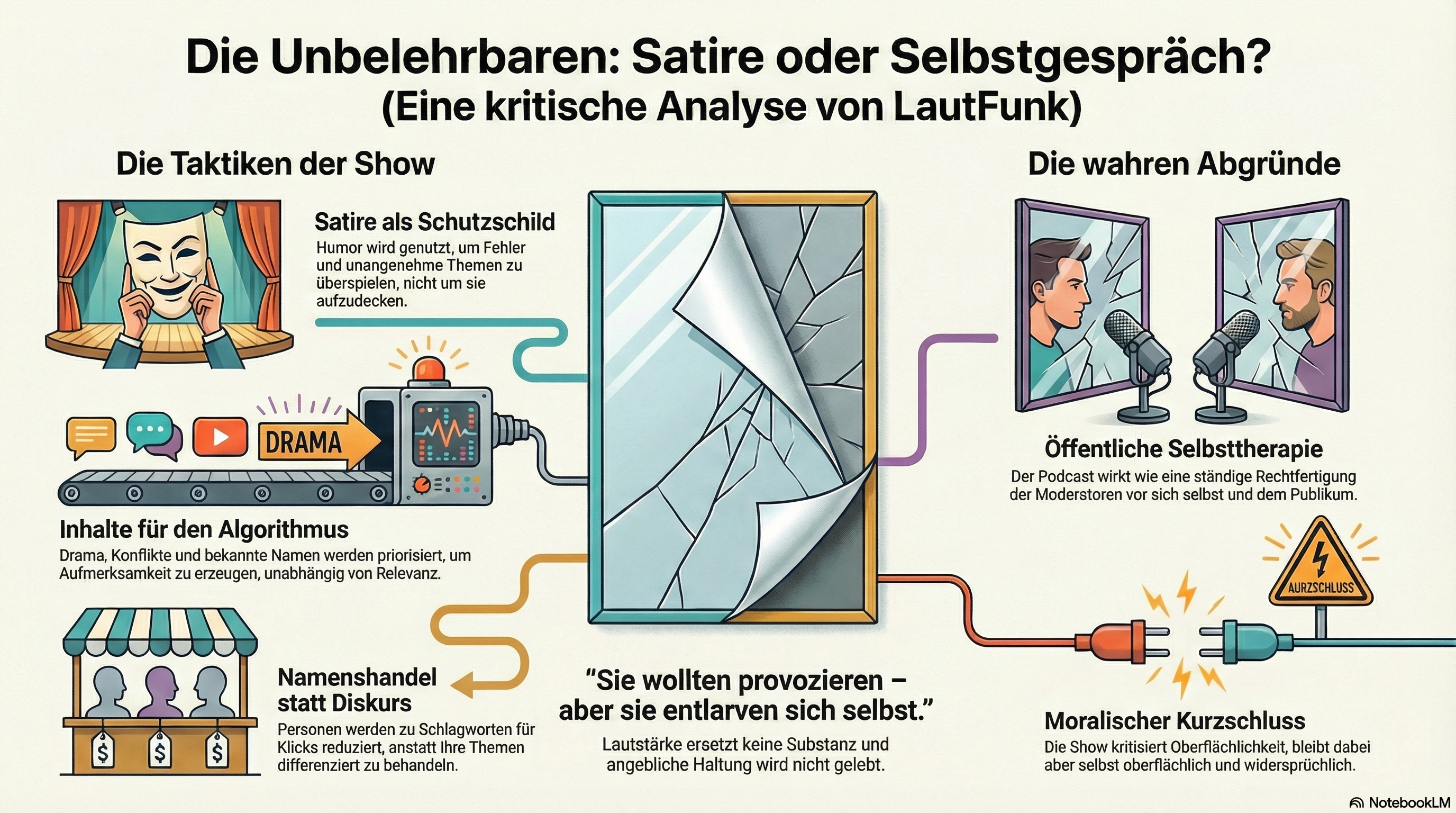
Click here for the NotebookLM
Disclaimer & legal notices
Note:
This episode is journalistic and satirical in nature.
All of these names refer to public persons and content that has already been published on social media or podcast formats.
The analysis is carried out within the framework of freedom of expression in accordance with Art. 5 GG.
Statements are contextualised and serve the media classification – not defamation.
Sources: Public streams, transcripts, press reports.
All audio and text rights © 2025 LautFunk.
CC BY-NC-SA 4.0 license.
Links to the issue:
-
The TV Chest - Stars, Reality, Trash TV
-
Gossip Guy Malkiel
-
NotebookLM - The Unteachable: Satire, self-pity and the big bluff
-
The unteachable - A NotebookLM analysis between satire, algorithm and self-staging - YouTube
Advertising:
Contributors to this episode
Playing time: 0:13:31
Date of admission: 22.11.25
This episode is from season 4, there are a total of 4 seasons.
One According to Funk Publication Cartel Production - Where stories are transmitted unmistakably.
Podcast license:
This work is licensed under a Creative Commons Attribution-NonCommercial-ShareAlike 4.0 International License
Note: This post contains affiliate links. If you shop through these links, I'll get a small commission at no extra cost to you.
Related posts
Discover more from LautFunk Podcast & Blog
Subscribe to get the latest posts sent to your email.
Author: Sascha Markmann
Sascha Markmann is a creative mind with a moving biography – and a person who has rediscovered life after a stroke. After working as a paramedic and elderly caregiver, Sascha found his way into creative expression. As a blogger, podcaster, musician and visual storyteller, he brings together things that just don't fit at first glance: He combines his keen enthusiasm for technology – from self-hosted servers to electronic music production – with emotional depth and an oblique sense of humor. His contributions are somewhere between borderline, acid basslines and assistance – honestly, directly and with a wink. Guiding principle: “Audio-visual dullness with no usefulness – but perhaps that's why it's so valuable.” View all posts by Sascha Markmann