„Vom Streit zur Content-Maschine: Wie Psychologie und Algorithmen das YouTube-Drama am Leben erhalten.“
Wer sich über längere Zeit im Ökosystem von YouTube bewegt, kennt ein merkwürdiges Phänomen: Ein Kanal startet mit Technik, True Crime, Politik, Unterhaltung, Lifestyle oder gesellschaftlichen Themen – und irgendwann scheint sich alles nur noch um andere Creator zu drehen.
‘How do presumptions turn into apparent certainties? A media psychology analysis shows how narratives become entrenched in digital communities.”
The Internet doesn't forget, but it changes. Anyone who moves for a long time in highly networked and often conflicting online communities will witness fascinating group dynamic processes. When looking at such networks, it is rarely a matter of simply distinguishing between ‘truth’ and ‘lies’. Much more complex and methodologically revealing is the question of how information is processed within a group, evaluated linguistically and finally passed on with varying degrees of certainty.
“Afraid of failure as a mother or father with BPS? Specific strategies for emotion regulation and healthy boundaries.”
Can I be a good mother or father with borderline personality disorder?
Many people with borderline (BPS) will ask themselves this question at some point, especially if they already have children or are thinking about starting a family. The fear of one's own failure is often overpowering.
‘Philosophy and psychology show that: Those who hate don't let go. Real emotional distance only begins with indifference’
When people are asked about the opposite of love, there is often a word: hatred. The answer is a matter of course in everyday life. Love stands for affection, closeness and care, while hatred stands for rejection, hostility and distancing desires. At first glance, the matter seems clear. But is it really that uncomplicated?
“The crisis is often followed by icy self-hatred. This is how you break the spiral of shame and guilt and find your way back into regulation.’
It's a scenario that many of us know all too well. The storm is over. Perhaps it was an intense outburst of anger, a panic reaction from acute fear of loss, or a moment when the internal pressure became so great that self-harming behavior seemed to be the only functioning valve. While in the acute situation the adrenaline rushes and the body works in absolute survival mode, then, when the calm comes in, the inevitable emotional hangover follows.
“Trolling does not gain its power through arguments, but through tied attention. This article shows how you distinguish destructive patterns from genuine criticism and sovereignly protect spaces of discourse.”
An everyday scene in the comment columns under a video, podcast or blog post: A community exchanges arguments on a subject, questions are asked and answered objectively. Suddenly a post appears that completely misses the topic, contains an absurd insinuation or places a subliminal trickery. Within a few hours, the mood has turned throughout the discourse room. Instead of talking about the original thing, dozens of people are highly emotionally debating the provocation.
This phenomenon is an integral part of digital media culture. In order to counter it effectively, no blanket scolding about ‘evil trolls’ helps. It requires an understanding of the interplay between individual motivation, group dynamics and the technical architectures of our platforms.
Central guiding thesis:
Trolling gains power not because the provocation is particularly persuasive, but because it binds attention, shifts rules, and forces others to respond.
1. What is trolling and what is not?
The term troll has become widely used in public debates. It is often used as an argumentative abbreviation to devalue inconvenient criticism, sharp counter-opinions or simply rude behavior. This is problematic because it devalues the real, factual discourse.
A precise definition
It's not just the content of a single post that makes it trolling. Rather, the decisive factor is the recognizable pattern of behaviour: Are answers included and arguments examined – or are they merely a starting point for the next provocation?
For classification, a clean demarcation helps:
Criticism: Targets content, actions, or arguments. Even if it is presented harshly, unpleasantly or emotionally, a factual reference remains recognizable.
polemics and satire: Use stylistic means such as aggravation, exaggeration or irony, but represent a clear, comprehensible position in terms of content.
Insult: A direct, usually affective attack on a person who does not necessarily follow a long-term disruptive strategy.
Trolling: A recurring communicative behavior pattern in which provocation, confusion or thematic derailment are in the foreground and factual attempts at clarification repeatedly run into the void.
Hate speech and threats: May be criminally relevant depending on the wording, context and circumstances. Whether a specific statement is punishable depends on the relevant criminal offences and must be assessed on a case-by-case basis.
2. Trolling or misunderstanding? The three-level model
A key problem in practice is: We can't look people in the head. The inner intention behind a comment is not unequivocally recognizable from the outside. A poorly formulated sentence, irony without context or a technical misunderstanding can seem like a provocation at first glance.
In order to avoid premature convictions and to protect legitimate criticism, the evaluation is recommended along three levels:
Plaintext
1. Is the statement only inconvenient or factually wrong? (No trolling) 2. REACTION → How does the person react to a factual clarification? 3. MODEL → Does dodging and provoking repeat itself systematically?
The content level: Is the article merely critical, unconventional or steeply thematic? Dissenting opinion, even if ill-founded, does not in itself constitute trolling.
The response level: What matters is what happens after an objective answer. Does the person respond to arguments? Does it acknowledge facts or correct misunderstandings? Or does she completely ignore the answer and immediately put the next needlestick?
The model level: Trolling rarely appears in the first step, but in the course. Is the behavior permanently destructive? Are new post-war locations constantly being opened up? Are mutual agreements ignored?
Principle: It is not the single provocative sentence that decides whether it is trolling, but the recurring pattern of provocation, reaction and re-escalation.
A case study from practice
How this behavioral dynamic happens in reality can be illustrated by a typical sequence in a comment column:
A commentary appears under a podcast episode: “It is a pity that you treat the subject so superficially and conceal important facts.”
The reaction: The moderation team responds objectively, asks for specific points and offers suitable supporting documents.
The evasion: The author does not address the facts, but unfoundedly requests more and more specific evidence (Sealioning).
The escalation: When these are also delivered, he declares all sources to be biased, takes up a legacy of the moderation team (Derailing) and accuses the editors of suppressing uncomfortable voices.
The victim role: After the removal of the non-topic contributions, the author publishes screenshots of the deletion and presents himself as a victim of alleged censorship.
If one analyzes this course with the three-level model, it becomes clear: The first comment was not yet proof of trolling. Only the systematic refusal of a factual clarification, the constant postponement of the requirements and the targeted victim staging reveal the destructive pattern.
3. The Toolbox of Provocation: Typical troll strategies
Those who know the typical patterns of digital interference experiments can classify them faster and lose less energy to them.
📌 info box: How do you recognize strategic trolling?
Derailing: The actual topic is deliberately replaced by a non-specialist, emotionally charged accusation.Example: In a technical discussion about the audio quality and compression of a podcast format, someone repeatedly writes: “Interesting that you are talking about sound quality, but never about why your moderator deleted a specific comment three years ago.”
Sealioning: The seemingly polite but endless reclaiming of evidence and explanations with the aim of exhausting the counterpart by sheer perseverance. Sealioning is not available for a single demand, but only when delivered answers are systematically ignored.
Concern Trolling: Alleged concern is used as a rhetorical camouflage to subtly devalue people, content, or projects.Example:“I only mean well with you, but with this topic you are ruining your reputation.”
Moving the Goalposts: As soon as a required condition or document source has been delivered, a new, even more difficult requirement is immediately made.Model: "Show me a source." → Source is called. → ‘One source is not enough’ → Three other sources will be provided. → ‘These are all courtesy studies.’
Dogpiling: A targeted or spontaneous mass attack in which numerous accounts interact simultaneously with a single person or moderation. This can give the impression that the attacking position represents an overwhelming or representative majority opinion – although often only a particularly active and mobilised group becomes visible.
Sock puppets: A single person uses multiple second or fake profiles to artificially fuel discussions, self-consent, or fake a supposedly broad and independent critique.
Ironic camouflage (‘just fun’): After a clear crossing of the border, one’s own intention is retroactively ridiculed in order to present the backlash as ‘hypersensitive’ or ‘humorless’.
4. Why people troll: Personality meets situation
In psychological research, trolling is often associated with the personality traits of so-called Dark tetrade (Sadism, narcissism, psychopathy, Machiavellianism). The 2014 study by Buckels et al. shows statistical correlations – especially with regard to so-called everyday sadism, i.e. the tendency to feel pleasure in the frustration or helplessness of others.
However, no hasty conclusions can be drawn from this:
These are: statistical correlations, Not for compelling reasons.
An online comment can be No clinical diagnosis or remote diagnosis.
Not every person who trolls online has a personality disorder – and not every person with such traits shows destructive online behaviour.
The Underestimated Impact of the Situation
In addition to stable personality traits, situational factors can play a significant role. The study by Cheng and colleagues (2017) shows that negative mood and an already destructive discussion environment can promote problematic behavior even in people who had not previously been noticed by trolling behavior:
Boredom and the need for attention: A steep provocation generates immediate visible resonance – often much faster and more reliable than an elaborately researched technical article.
Group dynamics and follow-up: If the basic tone in a comment column is already aggressive or cynical, the personal inhibition threshold for newcomers drops drastically.
Frustration and imitation: Those who feel unfairly treated themselves or observe that others succeed with aggressive methods are more likely to resort to similar means.
5. The accelerator I: The Psychology of Online Inhibition
Why is it so much easier to provoke others online than in a personal conversation? The American psychologist John Suler described this phenomenon in 2004 as the Online disinhibition effect (Online inhibition effect). It can be traced back to six key factors:
Dissociative anonymity: The feeling that the action on the net is separated from one's own everyday identity (“This is not me, this is just my profile”).
Invisibility: The other person is not physically present. At the same time, nonverbal signals such as facial expressions, gestures, tone of voice and immediately visible injury are missing.
Asynchronicity: Communication takes place on a time-delayed basis. One throws a comment into the room and can immediately turn away without having to endure the immediate reaction.
Solipsistic introjection: Since voice, facial expressions and immediate reactions are missing, an image of the other person is created in one's own head. His statements are associated with an imagined voice and personality, which only partially has to correspond with the real person.
Dissociative imagination: Some people experience the digital space like a world separate from everyday life or a game. After logging out, what is said there no longer seems to belong to one's own real identity and responsibility.
Minimization of status and authority: Traditional hierarchies, social statuary features and the authority of moderators are more easily receding into the background in the digital space.
Important differentiation: Online inhibition is not just toxic. She also has an benevolent side (benign disinhibition): It allows people to talk more openly about fears or strokes of fate, seek support and reduce stigma. The digital distance takes inhibitions in both directions.
6. The Accelerator II: Platforms, Interaction and Algorithms
Trolling does not occur in empty space. It encounters technical infrastructures which, through their architecture, favour certain behaviours.
Many social networks use referral systems, the assessment of which can be influenced, inter alia, by interactions such as clicks, comments, likes, redirects or length of stay (cf. Gillespie, 2018; EU Regulation 2022/2065 / DSA, Art. 27). However, which signals are actually crucial and how they are weighted differs from platform to platform.
Plaintext
[Provocative Commentary] ↓ [Many Outraged Responses and Discussions] ↓ [The System Registers High Activity] ↓ [Additional Visibility Can Be Created]
A factual contribution may receive ten responses, while a provocation triggers two hundred responses. Depending on the respective recommendation system, this high activity can generate additional visibility – even if most responses contradict the original statement.
This creates a systemic paradox: Outraged contradictions and factual counterarguments can also technically increase the scope of a provocation.
7. The indignation trap: The Asymmetric Discourse Game
One of the most effective patterns in trolling is the Indignation trap. It exploits the dynamics of emotional reaction and moderation in a targeted manner.
The Mechanics of the Trap:
The impulse: A targeted provocation is set.
The outrage: Community members react emotionally, invest time and try to refute the statement.
The decontextualization: The provocative person picks up a single, sharply formulated backlash and releases it from its original context.
The victim role: The author of the provocation now presents himself as a victim of aggressive attacks.
The accusation of censorship: If the moderation finally intervenes and removes the disturbing contributions, this is staged as evidence of alleged suppression of opinion.
This game is highly asymmetrical: The trolling account only takes a few seconds for a provocative throw-in, while the opposite side has to invest minutes or hours to limit the damage, explain matters and enforce rules.
8. The consequences for those affected and silent readers
The damage caused by trolling is not limited to those directly involved. It also influences the many silent readers who observe the climate of a community without commenting on it themselves.
When observers experience factual participants being wiped out, provocations tolerated, and forums dominated by perpetual disputes, they draw consequences:
Withdrawal and self-censorship: Constructive and expert voices discontinue their contributions because the argumentative effort is disproportionate to the yield.
Postponement of the group standard: The level of aggression is gradually increasing. What used to be considered rude becomes the new standard.
Erosion of trust: Confidence in fair rules of conversation and the platform's ability to act is declining.
Binding of moderation capacities: Moderation teams spend their time arranging deletion debates rather than actively shaping the community.
Key findings: A community is shaped not only by the visible contributions, but also by the people who no longer participate because of the prevailing tone.
9. Responding with system: The extended decision matrix
While the classic ‘don’t feed the troll’ rule is correct in its approach, it is too short-lived as a universal solution. Anyone who leaves false information, insults or attacks on others uncommented, leaves the public space to the loudest.
A step-by-step, situational approach is required:
Situation
Meaningful measure
objective
I don't know if it's criticism or trolling.
Provide one-off factual answers and ask specific questions
Checking Good Intention
Obvious provocation without reach
Do not reply; Hide or remove if necessary
Don't pay attention
High visibility misinformation
Correct once-in-a-lifetime factual for fellow readers
Providing orientation for the community
Repetitive derailment (derailing)
Formulating the limit of conversation and moderating other non-topic contributions
Protecting the discourse space
Dogpiling against community members
Limit attacks, protect those affected and temporarily restrict comments
Stop the spiral of escalation
Insult / violation of rules
Consistently delete comments, warn or block users
Enforcing domestic law
Targeted hate speech / threat
Securing evidence (screenshots), reporting and reviewing legal action
Protection and prosecution
Concrete text modules for moderation and community
Here are proven reaction patterns for practice:
In case of unclear criticism:"Thank you for your feedback. I am happy to answer the specific question on the subject: [Short answer]. Please stay directly with the topic of the article for further contributions.”
In case of repeated derailment:“This point has already been answered at this point. We will remove further contributions that derail the original topic again, without further discussion, in order to keep the space for the actual exchange.”
In case of misinformation (address of the participants):‘For all participants on classification: The claim that […] is not substantiated in this form. The available data show instead: […].’
In the case of personal attacks:“Content criticism and counter-arguments are welcome here at all times. However, personal attacks, insults and reductions are against our netiquette and will be removed.”
10. What Affected People Can Do Specifically
Anyone who becomes the target of trolling, targeted provocations or a dogpile is often under considerable pressure to act. Each new notification creates the feeling of having to react immediately, explain yourself or defend your reputation. However, it is precisely this compulsion to react that often forms part of the dynamics of the attack.
1. Do not respond in the first affect
An emotionally formulated response can later be detached from the context and used against the affected person. Therefore, it makes sense to create a distance first: Turn off notifications, leave the comment section for some time and ask a second person for a sober assessment. This does not mean that you are right about the attack – it simply means determining the timing and form of your own reaction.
2. Distinguish between clarification and justification
A factual clarification can be important for the participants. An endless justification against a person who does not want to accept an answer, on the other hand, consumes above all time and strength. A proven structure is:
‘The claim is false. For the classification of all participants, we put the facts right: […]. We will not go into any further detail on repetitions of the same allegation that has already been answered.”
3. Securing evidence in an orderly manner
Relevant content should be documented in case of repeated attacks, threats, identity abuse or coordinated campaigns. This includes not only individual screenshots, but also, if possible, date, time, username, platform and the full conversation context. An orderly documentation shows whether there is a recurring pattern, an escalation or a targeted campaign.
4. Organize support
Those affected do not have to cope with a major escalation alone. Trustees or team members can view comments, arrange evidence, take on moderation tasks, or help distinguish between legitimate criticism and targeted attacks. Especially with a dogpile, it is relieving not to have to constantly check your own account yourself.
5. Controlling digital access
Blocking, muting, restricting and deleting are not moral defeats. These are technical tools that people use to control access to their communication space. No one is obliged to make a stage permanently available to a person simply because he or she refers to his or her attacks as a ‘debate’.
6. Do not downplay in serious attacks
Concrete threats, reenactments, disclosures of personal data (doxing) or systematic attempts at intimidation no longer belong in the category of ordinary Internet provocation. In such cases, the safety of the data subject shall take precedence over any public discussion.
11. Moderation and censorship: An important distinction
As soon as posts are deleted or accounts are blocked, the word ‘censorship’ quickly falls. Here a clear conceptual distinction is necessary:
State censorship in the constitutional sense: A preventive state control in which a publication is pre-examined, approved or prevented (cf. Art. 5 (1) sentence 3 GG; BVerfGE 33, 1).
Private Moderation: Operators and platforms can decide on the basis of their rules which contributions remain in their communication room. This is not to be equated with state pre-censorship. Nevertheless, moderation decisions can be unfair, inconsistent or critical.
Anyone who runs a forum, podcast channel or blog provides a space for exchange. Household law, however, is not a license for arbitrariness: Good moderation should be transparent, comprehensible and applied as uniformly as possible. This is the only way to maintain community trust.
12. Frequently Asked Questions (FAQ)
Is every provocation on the Internet trolling?
No. Even harsh criticism, polemics, misunderstandings and rude comments are not automatically trolling. Decisive is the recurring behavior after a factual clarification.
Should trolls always be ignored?
Not always. For small provocations with no reach, ignoring can make sense. Visible misinformation, attacks on third parties or rule violations, on the other hand, should often be briefly classified or moderated in order to give orientation to the community.
Is deleting comments censorship?
Private moderation within the framework of domestic law is not state censorship. Platform operators are allowed to set rules for their discourse space, but should enforce them transparently and comprehensibly.
Why do people react so strongly to trolling?
Provocations often address moral indignation, a sense of justice, or a desire to immediately correct false claims. This gives the impression that one has to react immediately – a dynamic that can be exploited in a targeted manner in strategic trolling.
Conclusion: Drawing boundaries is not a defeat
Trolling lives on the assumption that any provocation expressed has a right to a content stage. That is not the case.
A healthy digital discourse space does not arise by itself. It requires active care, clear lines and a willingness to set boundaries. The consistent suppression of interference attempts is not a sign of weakness or lack of ability to debate, but the basic prerequisite for appreciative communication on the network to take place at all.
Literature and sources
Buckels, Erin E.; Trapnell, Paul D.; Paulhus, Delroy L. (2014):Trolls just want to have fun. Personality and Individual Differences, 67, pp. 97-102.
If you want to deal more intensively with trolling, digital aggression, online inhibition and dealing with destructive discussions, you will find well-founded backgrounds and practical strategies in these four German-language books.
🔥 1. Hatred on the Net
Ingrid Brodnig
Ingrid Brodnig explains how hate comments, targeted provocations, bullying and false claims are changing digital discussions. Her concrete recommendations for dealing with aggressive rhetoric and escalating comment columns are particularly helpful.
Particularly suitable for: Trolling, hate speech, counter speech and community moderation.
The book describes how the Internet influences our thinking, perception and social behavior. It provides an understandable psychological framework for anonymity, digital identities, online inhibition and changed forms of communication.
Particularly suitable for: Online inhibition, anonymity and psychology of digital communication.
This book explores how public debates are becoming increasingly aggressive through emotionalization, hate speech, fake news, and rhetorical manipulation. At the same time, it shows how to recognize such strategies and react meaningfully to them.
🛡️ 4. Objection! – Counter conspiracy myths and fake news
Ingrid Brodnig
The focus of this book is on practical counter-talk. It explains how to correct false claims and manipulative argumentation patterns without grinding into endless justification loops.
Particularly suitable for: Moving the goalposts, fact-resistance and factual counter-talk for fellow readers.
Note: The marked links may be affiliate links. If a purchase is made through such a link, we may receive a small commission. For you, the price does not change.
Glossary: Terms related to trolling, net culture and moderation
C
Concern Trolling A rhetorical tactic in which a person protects alleged concern or benevolence (“I only mean well with you …”) to subtly unsettle, devalue or slow down a project, topic or person.
D
Derailing A disruptive strategy in digital discussions in which the actual core topic is deliberately distracted and displaced by unrelated, highly emotional accusations or past conflicts.
Dogpiling A spontaneous or deliberately coordinated mass attack in which a large number of accounts simultaneously interact with a single person or moderation. This creates the impression of an overwhelming majority opinion and builds up massive social pressure.
Doxing (also Doxxing) The malicious research and publication of a person's private, personal data (such as home address, telephone number, employer or clear name) on the Internet in order to intimidate or expose them to real dangers.
Dark tetrade A model from personality psychology that describes four interrelated characteristics: Narcissism (self-indulgence), Machiavellianism (manipulation), psychopathy (lack of empathy) and everyday sadism (joy at the frustration of others). With regard to trolling, there are statistical correlations here, but no compelling causalities.
E
Indignation trap An asymmetrical discourse dynamic: A targeted provocation triggers emotional outrage among those involved. The provoked person is then picked out a sharp backlash to portray them as aggressive and push the original provocateur into the victim role.
H
Domestic law (Virtual domestic law) The right of operators of digital spaces (blogs, forums, social media channels) to set rules for exchange (Netiquette). Enforcing domestic law by deleting or blocking infringing posts is a moderation measure and not state censorship.
M
Moving the Goalposts An argumentative evasive tactic: As soon as a required condition or document source has been delivered, a new, even more difficult requirement is immediately made, so that no proof is ever accepted as sufficient.
O
Online disinhibition effect (online disinhibition effect) A term coined by John Suler for the observation that people in the digital space reduce inhibitions faster than in face-to-face communication due to factors such as anonymity, insynchrony, invisibility and the lack of non-verbal signals.
S
Sealioning A special form of trolling in which a person, under the guise of apparent politeness, endlessly demands evidence, arguments and explanations. The aim is not to clarify facts, but to exhaust the other person by sheer perseverance and to tie them up in time.
Sock puppet (sock puppet) A second or fake profile used by a person to artificially fake majorities in their own discussions, to prove themselves right, or to criticize from a seemingly neutral perspective.
T
Trolling A recurring communicative behavior pattern in the net, in which provocation, confusion, thematic derailment or the triggering of emotional reactions are in the foreground and factual clarification attempts systematically run into the void.
"What's behind Borderline's black-and-white thinking? Find out why splitting occurs and how you can use specific DBT strategies to allow emotional shades of grey.”
Those who live with borderline symptoms or love a person who struggles with them may know these moments: Just there was still close, suddenly everything is in danger. This text is not intended to condemn, but to make it clear why this is happening – and how to find more nuances step by step.
"After policymakers blindly waved through Lanstrop's transport policy clearcutting, a bureaucratic fiasco is now revealed in everyday life. Without any on-site information on the new TaxiBus and with unrealistic travel times, student traffic to the Lünen Vocational College in particular will be systematically suspended.”
Those who live in the periphery in 2026 often experience the much-vaunted ‘traffic transition’ as a clear-cut transport policy. The youngest victim of this administrative deficiency management is the Dortmund district of Lanstrop. At the timetable change on 25 May 2026, the growing direct connection of the lines C4/C14 to Lünen was effectively buried. What has been touted as ‘needs-based modernisation’ turns out, on closer inspection, to be a dismantling that, as a result, acts like the product of a bureaucratic responsibilities carousel.
At a glance: What has changed in Lanstrop
range
Before (until 24.05.2026)
After (from 25.05.2026)
Connection to Lünen
Regular, spontaneously usable direct connection via the clock lines C4/C14.
Line 322 as a demand-only service (TaxiBus). Reservations must be made at least 60 minutes in advance. End at the station Preußen.
Pupil traffic (line 22E)
Several student-relevant driving opportunities in the morning and more flexible returns.
Reduced to a single morning ride with narrow, one-sided school bus logic.
Connection to Dortmund
Poetical 10-minute interval of the line 423 at the school's peak times.
Switch to a fixed 20-minute cycle (line 423), eliminating targeted amplifier runs.
The political repair company: First nod, then protest
The political chronology of the Lanstrop bus chaos borders on a lesson of local contradiction and subsequent political follow-up. At its hearing on 19 May 2026, the Scharnhorst District Representation initially recommended the relevant administrative proposal 01890-26 without any formal amendments. The subsequent political repair company gives an idea of how far-reaching the inspection in advance actually was: In its own request of 29 May 2026 for the meeting of 30 June 2026, the CDU Group openly acknowledges that the original administrative template presented the reality of taxi bus and student traffic as ‘insufficient and highly euphemistic’.
According to Group President Jürgen Focke, the submission did not allow any conclusions to be drawn as to the actual outcome of the agreement. It is an implicit admission that the local bodies did not fully understand the scope of the decision at the May vote. Only after affected citizens and parents' initiatives expressed massive protest at an on-site appointment in a supermarket parking lot on May 28, did local politics switch to crisis mode.
The social media double game: From co-decision-maker to ‘savior’
This contradiction is particularly evident in the public relations work of the SPD local association Scharnhorst-Kirchderne. While the social democratic representatives in the political bodies allowed the far-reaching cuts to pass in May without any formal objections, the party already staged itself on Facebook as the spearhead of the protest on 27 May 2026, just two days after the fateful timetable change.
In a video published there, a SPD representative stands at the stop Dyer road, points to the newly displayed VKU timetables and explains with regard to the interrupted connections: “And that's something we want to change. We won't let that sit on it …’ This rhetorical bridge raises questions: Why does a governing party have to publicly protest against timetables, which it quietly decided a few days earlier in the town hall?
The construction site blind flight on the Färberstraße
Under pressure from a citizens' initiative that quickly collected over 2,000 signatures, local politicians are now hastily trying to distribute cosmetic plasters. At the centrally located stop Dyer road – Lanstrop’s main transport hub in close proximity to local shopping facilities – the dilapidated, seatless waiting house was demolished. In another Facebook video, the SPD praises this as a success: DSW21 has placed the stop on the priority list and a larger, more beautiful waiting room with new seats is to be created.
But while the PR drum is stirred in the network, the current state on the Färberstraße reveals the typical administrative ignorance towards the passengers on site. The reality of Lanstrop's main artery is currently a single mess:
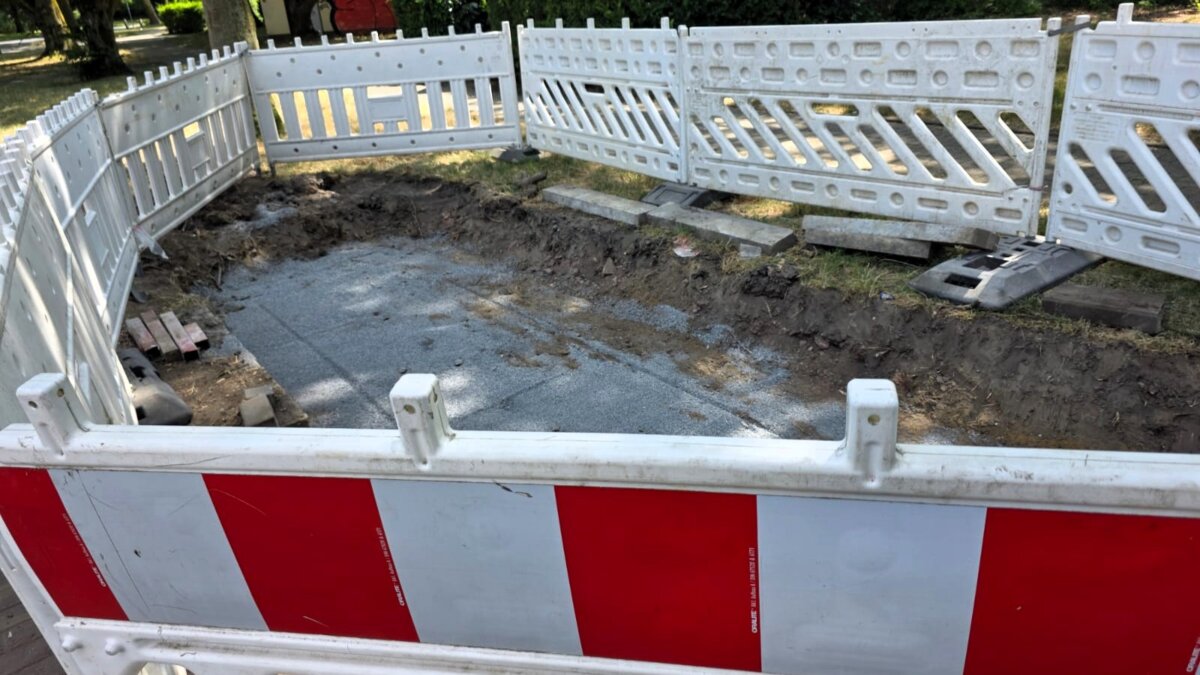
No replacement stop, no sign: Although the dyer road is purely a construction site, no replacement stop has been set up. Buses continue to depart from the construction site, but there is not a single stop sign on site to indicate this.
The total information vacuum: There is not a single timetable or information material on the entire construction site. Passengers do not know whether buses stop here at all, when the remaining lines depart, or which different lines currently serve this construction site area at all.
Exclusion of the older generation: While planners like to refer to digital apps internally, older people without a smartphone are particularly helpless at the nameless construction site. You have no way of knowing when and if a bus is coming.
Unclear perspective: It is still unclear when the new station will be completed. So far, there is only one construction site to be seen. The citizens were not informed about anything in advance and left completely unclear.
The fact that the local politics of the SPD prefer to post advertising-effective videos on their channels, instead of facing the critical press questions of our editorial staff, leaves an extremely bland aftertaste. It seems like an attempt to flatter the population shortly before the upcoming elections and to soothe the displeasure, but without actively solving the real, profound connection problems to Lünen.
In addition, complex replacement concepts are now brought into play in retrospect to cushion the self-inflicted Lünen debacle. In the video, for example, the SPD promises to work to extend bus line 420 (coming from Aplerbeck) beyond the former Wittfeld terminus to Prussian station and Lanstrop. Also a connection of the express bus line X6 to the stop Alexiastraße/Old Heath is being discussed. Whether these vague statements of intent ever see rail or road, however, remains completely open.
The double blow: Cut off in both directions
The transport policy reality for Lanstrop has been a systemic isolation since the end of May. As a result, the district is circumcised in both directions:
1. The barrier axis to Lünen (line 322)
As a replacement for the lines C4/C14, line 322 was introduced as a pure on-demand service (TaxiBus). At the official request of our editors, the transport company now unavoidably confirms: ‘The previous direct link […] shall not be replaced by an equivalent direct link. There has been no direct, continuous connection to Lünen-Zentrum in everyday traffic since 25 May 2026.’ Journeys must be booked at least 60 minutes in advance and end at the Prussian railway station.
Analog blackout: None of the stops on Dortmund's urban area contain any indication as to how, at what cost or under what conditions the TaxiBus can be ordered at all.
Lack of accessibility: Passengers are not informed on site about the ordering channels via app, Internet and telephone or about the operating hours. On the part of the VKU, this purely digital/telephone procedure is defended – it corresponds to the "common practice in on-demand transport and has proven its worth in the past". However, for people with disabilities, the visually impaired or senior citizens without digital infrastructure, this information vacuum is a massive hurdle in everyday life.
2. The Education Scandal in Student Traffic (Line 22E)
The temporal incompatibility of the new student traffic is now an official case for the committees.
Radical coup: Where in the past three needs-based morning trips on the lines C4/C14 were flexible for the pupils, only a single calculated school bus of the line 22E has been running since the changeover.
The vocational college dead end: This remaining bus is one-sidedly optimised for the start of lessons at 08:00 am at the Gymnasium Lünen. However, the fact that lessons at the Lünen Vocational College already start at 7:30 a.m. was completely ignored in the original structure. How deep the arrow of this criticism sits, the VKU now proves itself in its opinion. It is acknowledged that the original plan was flawed: "In addition, it is currently being examined whether the offer can be extended by an additional journey from Lanstrop towards Lünen to the Berufskolleg. However, these considerations are still in the planning phase.”
The mathematical fiasco of the return journey: In the event of staggered school leaving, there is no consistently reliable return service from Lünen city centre that can be used on a daily basis. Should all students at the same time after the 6th When the hour is over, the space offered by the individual bus is unlikely to be sufficient.
3. Adaptation to Dortmund (line 423)
In order to dampen the displeasure in Lanstrop, Dortmunder Stadtwerke (DSW21) is selling an adaptation of line 423 towards Dortmund-Grevel as part of its ‘CityTaktPlus’ programme from 14 June 2026. The official announcement promises the use of articulated buses and a rigid 20-minute cycle during the day. What sounds like an offer offensive, however, turns out to be the end of the school-day amplifier rides in detail.
For the passengers, this does not mean a deterioration in every situation of the day, but it does mean a deterioration in those time windows in which so far school-day amplifier trips have condensed the offer. It is a planning intervention that binds Lanstrop more closely to the clock specifications of the Dortmund core network, while at the same time the historic connection to Lünen breaks away.
Transparency note: This presentation is based on official timetables, administrative templates, public announcements and written answers to press inquiries from our editorial staff. Requests that have not been answered or are answered late will be marked accordingly.
The Protocol of Incompetence: Who answered how
In order to clarify the responsibilities for this transport policy fiasco, our editorial team has confronted the involved bodies with hard press inquiries. The result is a document of organized lack of competence:
City of Dortmund: The Dortmund city administration refers above all to the formal state of competence. Politically, however, the question remains open as to how a Dortmund district can be practically less connected without Dortmund assuming recognizable responsibility for it. In addition, according to the city, no financial compensation is provided for the kilometers on Dortmund territory. Politically, this seems like a zero-euro solution for a real deterioration on the ground.
DSW21: At the official press request, the group communication stated in writing at the beginning of June that ‘Currently no adjustments planned by DSW21’ be. Only a few days later, the official timetable data were in recognizable contradiction to this statement. The altered timing of line 423 must at least have been very advanced in terms of planning at that time. Technically, DSW21 also revealed a terrifying standstill: A digital, dynamic connection fuse between the control centers of DSW21 and VKU does not exist in 2026. In the event of delays in border traffic, communication is purely manual via telephone and e-mail.
VKU (Verkehrsgesellschaft Kreis Unna): After an initial delay, the VKU now disclosed its imputed figures and provided the economic justification for the clear-cutting. Accordingly, the threshold of 1,200 daily routes enshrined in the local transport plan was not met for the Lünen-Dortmund-Nord corridor. According to the VKU, the old lines C4/C14 recorded only around 140 passengers on one working day, spread over about 60 journeys – which means that statistical capacity utilisation of only 2.4 Passengers per journey corresponding. In order to avoid costs for a ‘parallel offer’ on the route section to Lünen-Zentrum, cap the direct line and force passengers at Prussia station to switch to line 22. Brisant: The VKU officially confirms that: ‘there is no binding […] connection guarantee deposited on the system’;. If you miss the connection due to delay, you are unlucky: ‘A general connection or replacement transport is currently not foreseen.’ In addition, it is acknowledged that the operating hours (Mon-Sat, 9:00 a.m. to 6:00 p.m.) were deliberately so narrow, as the offer was primarily intended as a pure ‘Basic supply services’ (Purchases, doctor's appointments) was designed.
City of Lünen: The neighboring city of Lünen largely rejects the responsibility. Daniel Claeßen, head of the press office, said that although the system change was "expressly welcomed" during the formal procedure, he now emphasises defensively that the operational stability of individual connecting lines is the responsibility of the VKU. That it is the massive, inner-city construction site closures of the city of Lünen (default Jägerstraße / Bürgerplatz) that make the junction line 22 chronically untimely and thus completely destroy the transfer concept at the Prussian station for the Lanstroper, is dismissed as a pure problem of the neighboring district.
VRR: The Verkehrsverbund Rhein-Ruhr washes its hands in innocence. In its apps, the VRR merely reflects what the operators provide in terms of data. If the digital booking link for the TaxiBus in the app collapses as soon as the 60-minute deadline has expired, the pure design matter of the VKU. The large European network does not feel responsible for the poor user-friendliness at the tariff line.
SPD Scharnhorst / Local politics: While the social media channels of the local association are intensively used for citizen-oriented PR, the principle of silence prevails in hard inquiries. The Scharnhorst SPD faction under Ralf Römermann, which passed the controversial cut proposal in May without an amendment, reacted with complete silence to the targeted questions about their own voting behavior despite repeated requests from our editors. The selective communication behavior leaves a bland aftertaste: While one deliberately avoids critical journalistic questions, one's own staging on Facebook is solemnly continued.
Conclusion: If administrations block, operators count purely on statistical thresholds and look away from local politics, the traffic turnaround becomes a farce. For the students in Lanstrop, only one thing remains in the end: The bitter realization that transport policy services of general interest also end at the city border.
Sources and documents
Timetable line 322 – Transport company Kreis Unna (VKU)
Timetable line 22E – Transport company Kreis Unna (VKU)
DSW21 driving publication – Official announcement of ‘CityTaktPlus’ (state of play: June 2026)
Administrative template 01890-26 – Updating of the local transport plan, City of Dortmund
Urgent motion by the CDU Group – Dortmund-Scharnhorst District Representation of 29.05.2026
Social media sources (Facebook videos) – Official video releases on the public Facebook page of the Social Democratic Party of Scharnhorst-Kirchderne (Post of 27.05.2026 under the title ‘Dortmund hat Krafft!’ concerning the stop Färberstraße and follow-up posts on the line extensions of the 420 and X6).
Written opinions – Official press replies of the City of Lünen, the City of Dortmund, the DSW21, the VRR and the official reply of the VKU (Inga Fransson) of 7 July 26 to the LautFunkEditorial staff.
Your experience counts!
Are you or your children affected by the timetable changes in Lanstrop? Have you experienced connection breaks at the station Preußen, stand in front of unlabeled stops or have problems with the way to school to the vocational college? Send us your testimonials, notes or photos directly by e-mail to redaktion@lautfunk.de – we stick to the story.










 English