

Those who live with borderline symptoms or love a person who struggles with them may know these moments: Just there was still close, suddenly everything is in danger. This text is not intended to condemn, but to make it clear why this is happening – and how to find more nuances step by step.
It's an experience on an emotional slingshot seat. The world can still be immersed in a warm, facing light. The partner is experienced as a soul mate:r, as the only person who ever truly understands you. But then one supposed little thing is enough: A delayed response to a message, a misunderstood look, or a distracted nod. In fractions of a second, the mood can tilt, and everything plunges into deep uncertainty. The feeling of tie-up becomes existential fear or disappointment, and the other person is suddenly perceived as cold or derogatory.
This phenomenon is seen in psychology as ‘Splitting’ (divide) or Black and white thinking known. This pattern occurs in many people with borderline symptoms and is closely related to emotional instability, loss anxiety, and intense difficulties in relationships. For those affected, it often feels like a permanent change without transitions – there is no lukewarm water, but only boiling hot or icy cold.
This article sheds light on the psychological explanatory models of this thought pattern. We look at typical everyday examples, analyse the burdensome consequences for relationships as well as self-esteem and, above all, develop Concrete, therapeutically proven strategies, to rediscover the relieving shades of grey of life.
1. What is splitting? The Dynamics of All-or-Nothing
To understand black and white thinking, it is important to know that this is not a conscious decision or evil intention. Splitting is an unconscious, automatic attempt by the psyche to deal with overwhelming emotions.
The Challenge of Sustaining Ambivalence
Human relationships and everyday situations are inherently complex and contradictory. A person can love us wholeheartedly and still be tired, annoyed or distant at a certain moment. A situation can be frustrating, but still involve positive aspects. This simultaneity of apparent opposites is called ambivalence.
When intense emotional tensions arise, people with borderline symptoms often find it difficult to endure this ambivalence. When a caregiver sets a boundary or disappoints, the positive image collapses at the first moment. Since it is difficult for the psyche to integrate the two opposing perceptions (‘I love this person’ and ‘This person is hurting me right now’), it tends to divide the picture:
- The idealization: The opposite is perceived as absolutely perfect, flawless and saving.
- The devaluation: The opposite is experienced as empathyless, cold or repulsive.
Emotional memory during the splitting phase
A particularly stressful aspect of splitting is that in a phase of devaluation, access to positive emotional memories may be blocked. When the other person is perceived negatively, it often feels to the affected person in the here and now as if the relationship is always It was painful. The common happy moments, the evidence of loyalty and affection are emotionally hardly retrievable at this moment.
2. Why does the psyche react this way? The background of the pattern
Even though black-and-white thinking causes a lot of suffering in the long term, it fulfils a psychological function in the short term: It is an archaic attempt to overcome emotional overload.
Reduction of complexity with high tension
Many people with borderline symptoms experience feelings faster, more intense and more prolonged. When in an ambiguous situation (e.g. mixed feedback in the workplace) the internal tension increases massively, the psyche tries to arrange the unbearable chaos. It radically simplifies reality:
“The criticism means that I am absolutely incapable and they want to get rid of me.”
This thinking creates acute pain, but it creates a painful clarity. For an overloaded nervous system, a supposedly clear, negative certainty can be easier to process at the first moment than the excruciating uncertainty of a complex reality.
The interplay of causes
How does this dynamic arise? Today, science is based on one Biopsychosocial model off. This means that biological predispositions interact with psychological and social factors.
On the biological side, a particularly irritable or quickly activated nervous system often plays a role. On the psychosocial side, there are often early relationship experiences, emotional invalidation (the repeated devaluing or ignoring of one's own feelings by caregivers), trauma or persistent insecurity in childhood. The child may have had to learn to divide signals into ‘safe’ or ‘dangerous’ at lightning speed due to the lack of reliable intermediate tones. This pattern then translates into adult life as an automated response.
3. The consequences in everyday life: Conflicting dynamics and self-sabotage
Although splitting reduces perceived complexity in the short term, the long-term costs in real life are high. It concerns partnerships as well as friendships, the profession and the relationship with oneself.
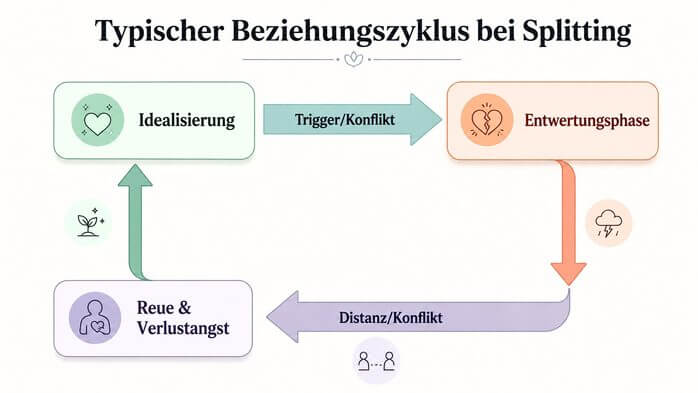
Recurring relationship patterns
Relationships can get into painful cycles through this dynamic, which are extremely exhausting for both sides:
- Idealization: Great closeness and euphoria determine the first time. The opposite is highly appreciated.
- The trigger: A careless word or unforeseen event triggers fear of loss or a sense of rejection.
- The devaluation phase: Fear turns into defense or anger. The other person's image turns negative.
- Withdrawal or conflict: There are disputes, accusations or distancing.
- The relief or remorse: As the emotional tension decreases, the ambivalence becomes more tangible again. Often, deep shame, feelings of guilt and the fear of having destroyed the relationship by the conflict follow.
For relatives and partners, this often feels like an unpredictable dance on the volcano, which can lead to emotional exhaustion and withdrawal.
Self-sabotage at work and in everyday life
Black and white thinking also affects self-image. Affected individuals tend to view themselves as either error-free or absolutely worthless.
A small mistake in the job does not lead to the idea of ‘I will correct this next time’, but to: ‘I can't do anything, I should quit immediately.’ Projects, training or employment relationships are sometimes impulsively interrupted in order to prevent a supposedly impending quitting or embarrassment.
4. The way to the grey area: Specific therapeutic strategies
Getting out of the vicious circle of splitting requires patience and continuous training. It is not a question of suppressing intense feelings, but of Cognitive flexibility increase in order not to be exposed to the emotional storms unfiltered.
In psychotherapy – such as dialectic behavioral therapy (DBT), mentalisation-based therapy (MBT), schema therapy or transmission-focused psychotherapy (TFP) – various approaches have proven successful. No method is automatically the best for everyone. The decisive factor is which approach suits the person concerned, the current life situation and the therapeutic relationship.
Here are four concrete techniques that can support everyday life:

Technique 1: Conscious pause (press pause button)
When splitting occurs, it usually happens in fractions of a second. The most important skill (a so-called ‘skill’) is to create a time gap between feeling and reaction.
- The practice: As soon as you notice that the tension increases and the thoughts radicalize, the rule applies: No impulsive decisions, no clarifying news, no accusations.
- The inner monologue: “I notice that I am extremely tense right now. My thinking slips into all-or-nothing. I wait for my reaction until my inner tension has subsided again.”
- If necessary, use intense sensory stimuli (such as cold water on the face or movement) to shut down the nervous system.
Technique 2: Balancing Facts against Feelings
In moments of high emotionality, we tend to Emotional Evidence: “I feel rejected, so am I do, too.” To break that, a factual view of the situation, such as an inventory, helps.
| The Thought / The Feeling (black and white) | Factual facts (Reality) |
| "She hasn't answered me in two hours. She doesn't care about me.” | She has a long day at work today. Yesterday we had a good conversation. She usually gets in touch as soon as she has time. |
| “My boss criticises my presentation. I'll be flying out of here soon.” | The criticism referred to a few details. I can continue the project itself. There was no warning. |
Writing helps to reactivate the rational part of the brain and dampen the emotional impact.
Technique 3: The magical ‘and’ (establishing dialectics)
A core aspect of therapeutic work is dialectics – recognising that two apparent opposites can be true at the same time. Black-and-white thinking separates with a hard ‘or’. Discharge is caused by the word ‘And’.
Try replacing extreme reviews with connecting sentences:
- Old: “Either you support me 100% or you are against me.”
- New: “I am just angry and disappointed with your rejection, and I know at the same time that you love me and are there for me.”
- Old: “I made a mistake, I am a total failure.”
- New: “I made this mistake, and I have done many things well in the past.”
Technique 4: Search for alternative explanations
In borderline symptoms, in moments of uncertainty, one tends to immediately interpret other people's behavior as personal rejection. Challenge yourself to systematically find alternative, neutral explanations.
Example: A friend greets in passing only fleetingly and goes on.
- Alternative A: ‘He was deeply absorbed in thought and did not perceive me properly.’
- Alternative B: “He is in an extremely hurry today and is under time pressure.”
- Alternative C: ‘He is not doing well himself and his head is full.’
5. Notes for relatives: Dealing with dynamics
If you are a partner, friend or family member in a devaluation phase, this can be very hurtful and confusing. De-escalation and self-protection go hand in hand here.
- Do not go into endless justifications: If the affected person is in an acute emotional overload, logic is hardly accessible at first. Any justification is often understood as a counterattack.
- Validate feelings, maintain boundaries: Take the pain seriously, but set clear limits on hurtful behavior.
- Example of wording: “I see that you are very angry and hurt right now. I want to clarify this with you. But I don't want us to insult each other. Let's talk in half an hour.”
- Signal reliability: Show that you hold on to the relationship despite the conflict. The signal should be: “I'm retreating for a moment to calm the situation, but I'm not leaving. Our relationship is out of the question.”
Conclusion: Life wins in the nuances
Breaking through black and white thinking is not a linear, simple process. It's more like learning a new language. It's completely normal to stumble at first and fall back into old patterns.
The decisive turning point is the moment when noticed, Thinking is going to extremes right now. This mindful observation of one's own processes is the real key to change.
Allowing shades of grey may sometimes take away a certain dramatic intensity from life – but it gives something far more valuable: Stability, emotional protection, deeper inner peace and relationships that are not immediately shaken by conflicts. The world doesn't have to be perfect to be good. And we don't have to.
Important note & First Aid
This article is intended to provide information and better understanding; It does not replace professional diagnostics or psychotherapy. If you recognise yourself in these patterns and suffer from them, do not hesitate to seek professional support – especially if self-harm, suicidal ideation or severe life crises play a role.
Contact points & Help:
- Therapy place search:therapie.de(Platform for the search for psychotherapists in Germany)
- TelephoneSelf-care: 0800 / 111 0 111 or 0800 / 111 0 222 (Free, anonymous and available 24/7)
- Number against grief (for children & adolescents): 116 111
- Info-telephone depression: 0800 / 33 44 533
- Regional: The Social Psychiatric Service (SPD) of your city or county offers free, non-bureaucratic crisis counselling. In acute emergencies, please contact the nearest psychiatric clinic or emergency call (112).
📚 book recommendations: Understanding Borderline & Splitting
1. For the entry & Affected
- ‘I hate you – don’t leave me: Understanding the Borderline Personality“
- From: Jerold J. Kreisman & Hal Straus (Kösel-Verlag)
- That's what it's all about: The worldwide bestseller. He describes the emotional tornness and the eponymous interplay of idealization and devaluation extremely pictorially on the basis of many case studies.
- Perfect for: A deep, emotional understanding of inner dynamics.
- ‘Guide to Borderline Disorder: Information for affected persons and relatives“
- From: Prof. Dr. Martin Bohus & Martina Wolf (Hogrefe Verlag)
- That's what it's all about: Absolutely factual, scientifically sound and completely free of stigma. Written by the leading DBT expert in German-speaking countries.
- Perfect for: All those who are looking for crystal clear facts and first direct insights into the functioning of the therapy.
2. Especially for partners & relatives
- ‘Stop the egg dance: For relatives of people with Borderline“
- From: Paul T. Mason & Randi Kreger (Beltz Verlag)
- That's what it's all about: The absolute standard work for the environment. It shows concretely how one protects oneself in everyday relationships, sets boundaries and breaks out of unhealthy dynamics without devaluing the affected person.
- Perfect for: Partners: members of the family who often feel exhausted or helpless in everyday life.
- ‘Borderline - Self-help book for relatives“
- From: Christa Windmüller (Thieme Verlag)
- That's what it's all about: A modern guide that radically focuses on the mental health of relatives. He combines specialist knowledge with exercises on nonviolent communication (NVC).
- Perfect for: Relatives who are looking for a very solution-oriented, practical guide.
3. For active practice & Self-help
- ‘Understanding and managing borderline (accompanying book)“
- From: Ewald Rahn & Karsten Giertz (Psychiatry publishing house)
- That's what it's all about: Not a pure reading book, but a real workbook for therapy and self-help. It contains practical exercises for emotion regulation, with which you can train the pause mentioned in the text directly.
- Perfect for: Those affected who are actively working on their patterns and want to have exercises black on white in front of them.
Glossary: The most important technical terms briefly explained
| Technical term | Easy to understand explanation |
| ambivalence | The simultaneity of opposing feelings, thoughts or desires. In relationships, for example, this means that you can love someone from the heart and at the same time be angry at them at the moment. |
| Biopsychosocial model | A scientific approach that states that mental conditions never have a single cause. They always arise from the interplay of biological factors (e.g. genetics), psychological aspects (e.g. stress processing) and social influences (e.g. childhood experiences). |
| Borderline symptoms / BPS | A psychic structure characterized by pronounced instability in emotions, self-image and interpersonal relationships, as well as increased impulsivity. |
| DBT (dialectical behavioral therapy) | A special form of cognitive behavioral therapy originally developed for people with borderline symptoms. The focus is strongly on mindfulness, emotion regulation, dealing with crises (stress tolerance) and interpersonal skills. |
| dialectic | A philosophical and therapeutic principle that states that two apparent opposites can be true at the same time. Healing here means replacing the hard ‘either-or’ with a connecting ‘and’. |
| Emotional evidence | A cognitive mistake in thinking in which the current feeling is equated with reality. Typical thought: “I feel rejected, so the other person also means evil.” |
| Emotional invalidation | Repeatedly playing down, ignoring or punishing one's own feelings through the social environment (e.g. sentences such as "Don't act like this" or ‘You're just imagining that’ in childhood). |
| devaluation | The opposite of idealization. At this stage, a person, situation or self is perceived as exclusively negative, faulty, cold or malignant. Intermediate tones are blocked. |
| idealization | An exaggerated, exclusively positive perception of a person or a situation. Weaknesses, errors or limits of the other person are completely hidden. |
| Cognitive flexibility | The mental ability to leave rigid thought patterns, change perspectives, and allow alternative explanations for the behavior of others or for situations. |
| MBT (mentalization-based therapy) | A psychotherapeutic approach that strengthens the ability to explain one's own behavior and the behavior of others by understanding underlying mental states (feelings, needs, intentions). |
| metacognition | ‘Thinking about your own thinking’. The ability to perceive one's thoughts, assessments, and emotional impulses from an overarching observer perspective rather than acting on them immediately. |
| Schematic therapy | A therapeutic method that combines behavioral therapy with deep psychological approaches. It aims at recognising and changing deep-seated patterns of behaviour and experience (‘schemata’) that arose in childhood. |
| Skills (skills) | Concrete strategies, techniques or actions that are specifically used in moments of extremely high emotional tension to shut down the nervous system without harming yourself or others. |
| Splitting | An unconscious protective and defensive mechanism of the psyche, in which reality, other people or self-image are radically divided into ‘only good’ or ‘only bad’ in order to avoid emotional overload. |
| TFP (Transmission Focused Psychotherapy) | A strictly modified, depth-psychological approach to borderline symptoms. Here, the therapeutic relationship in the here and now is used to visualize and work on unconscious relationship patterns and inner splits. |
Discover more from LautFunk Podcast & Blog
Subscribe to get the latest posts sent to your email.

 English