
Introduction: The End of Innocence in the Video Ecosystem
YouTube is no longer just a hosting service for music videos, tutorials or cat clips. With over 500 hours of video uploaded to servers every minute, it is arguably the most powerful infrastructure in the global attention economy. It's a highly complex, data-driven ecosystem where billions flow daily, careers are forged overnight through viral spikes, and just as quickly destroyed by orchestrated shitstorms. In this gigantic digital space, ethical boundaries are not only regularly renegotiated, they are systematically, calculatingly and algorithmically driven.
The central question that hovers over this entire construct is simple in its formulation, but frighteningly complex in its answer: Are clicks, traffic and retention enough to justify everything?
We're not talking about subjective taste issues here. No one needs to like a creator whose style is loud, glaring, or provocative. It's about something fundamental: Can everything be filmed, published, monetised through advertising and transhipped within reach – as long as the analytics are right? Can you put other people in dramatic, existential situations, degrade their privacy like a resource, spread lies or frame half-truths as absolute facts – just because the platform’s machine learning rewards this behaviour with increased playout?
The short answer is: No. The analytical answer requires a deep look into the engine room of the platform. If you want to be successful on YouTube, you play according to rules that are not in any community guideline PDF. They are hardwired deep into the code of the recommendation system. And these rules have devastating consequences for millions of viewers and society as a whole.
The drama backend: Why controversy is the most stable business model
The drama model works. It works so frighteningly well that it has become the most profitable business model for an entire industry of creators. And that's not because these people are fundamentally malicious, but because the system rewards, scales, and monetizes that very behavior.
Let's imagine the YouTube algorithm not as a mystical entity, but as what it is technically: An extremely efficient neural network trained by reinforcement learning. His only goal is to maximize session watch time and ad impressions. The machine is paying attention. It has no parameters for journalistic quality, truthfulness or ethical integrity of a video. It measures Click-through rate (CTR), Average View Duration (AVD), Scroll stop rates and Engagement metrics (Likes, dislikes, comments, shares).
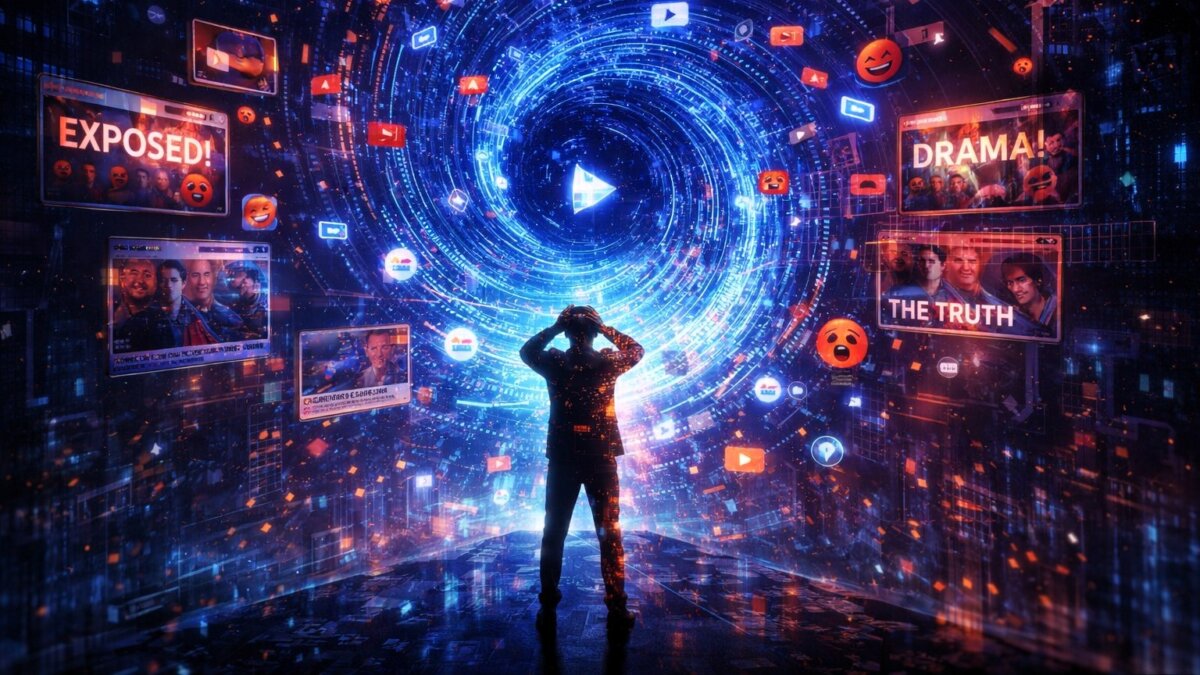
A video that makes viewers angry, outraged, or polarized creates a massive rise in these metrics. Anger is an unbeatable dopamine trigger. If two creators have exactly the same reach and one publishes a well-founded two-hour interview, while the other drops a 15-minute ‘exposé’ about a colleague, the exposé will destroy the interview in almost all analytics. Not because the audience is necessarily stupid, but because the platform's architecture places emotional responses above cognitive reflection. The AI learns: This video creates an emotional reaction that prevents the user from closing the app. So she pushes it into millions more feeds.
Historical Content Militarization and A/B Testing
This drama model is not a spontaneous invention of recent years. We have been witnessing a continuous development for some time, which we can call ‘content militarisation’. In the early years, YouTube dramas were harmless noise: One creator criticized another, there was a response video, the community discussed in an orderly fashion.
Then the mechanics escalated through the professionalization of the channels. With the introduction of massive A/B testing tools for thumbnails and titles, creators learned to accurately measure what degree of toxicity brings the highest return on investment. The ‘Exposé’ video became the standard data-driven format. Creators began leaking private voice messages, stylizing screenshots from chat histories as evidence, and establishing personal destruction as a content pillar. The line between legitimate criticism and digital witch hunt disappeared.
The key catalyst was monetization. Due to the extreme watch-time of such dramas, the RPM values (revenue per mille) skyrocketed. The exposé mutated from a toxic slip-up to a highly efficient business strategy.
Parasocial warfare: The Weapon of Emotional Attachment
To understand why drama converts so well, we need to look at the interface between man and machine: The parasocial relationship. YouTube is designed to make viewers feel like they know the creator personally. The view directly into the camera lens, the vlogs from your own living room – all this suggests closeness and intimacy.
Now, when this creator uploads a drama video and positions himself as a victim or a just avenger, it activates real protective instincts among viewers. It is parasocial warfare. The creator outsources the conflict to his community. He doesn’t have to write threats himself – his highly emotionalised followership, tied to him, does that for him. This dynamic also forces other creators to jump on the bandwagon so as not to lose their own relevance in this overheated ecosystem. There is a perpetuum mobile of indignation.
The nomenclature of border crossings: Four levels of toxic content
The ethical border crossings on YouTube aren't all the same, but they're systematically building on each other. They can be divided into four precise stages before the system finally collapses.
Stage 1: Asymmetric information warfare (half-truths and framing)
Information is filtered and presented to support a predefined narrative. A creator isolates a 10-second clip from a four-hour live stream and removes the context. He quotes a tweet, but hides the rest of the thread. This is toxic because it is asymmetrical: Spreading a half-truth takes minutes and generates massive traffic. Refuting them cleanly with facts, context and sources costs hours or days – and the algorithm is usually no longer interested because the scandal has already cooled down.
Stage 2: The Breach of Informational Self-Determination (Doxing and Leaks)
Here, the content leaves the level of public persona and massively interferes with privacy. Creators publish private WhatsApp messages, display clear names, leak addresses, or show faces of uninvolved family members. The excuse is always: ‘The public has a right to the truth.’ Legally, this is usually a massive violation of personal rights and the GDPR. The fact that platforms hardly succeed here due to moderation residues does not legitimise the approach – it only reveals the serious bugs in content moderation.
Stage 3: The instrumentalization of protection officers
The darkest digital escalation stage: Creators who actively incorporate children and adolescents into their drama productions. Whether as crying ‘evidence’ in a public custody dispute, as a target for ridicule or as an emotional lever to put pressure on other creators. There must be no grey area and no discussion here: A child cannot give informed consent to publish content that leaves a permanent, toxic digital footprint. Children are not metrics. Children are not a content resource for the next viral thumbnail.
Stage 4: The Collapse of Reality (Scened Conflicts and Fake Drama)
Total detachment from objective facts. Stories are invented from the ground up, behind-the-scenes conflicts are contractually agreed upon, voice messages via AI (voice cloning) are falsified, accounts for staged shitstorms are purchased via bot networks. The goal is pure engagement farming. When the user base can no longer verify what is real and what is scripted, the basic trust in the entire platform erodes. In the end, this also affects the creators who do real, well-founded journalistic work.

The Breach into Reality: Stochastic Violence and the Battermann Case
So far, we've talked about digital mechanics, server infrastructures, and metrics. But there is an absolute red line that is torn when toxicity leaves the screen. When bits and bytes become real deeds. When the online beef no longer remains virtual, but leads to real attacks on real people.
Here the topic ceases to be a theoretical media analysis. Currently, channels such as The TV Chest or Maren Giertz This is a frightening development: Real, physical attacks – as in the case of Frank Battermann of YouTube Channel The TV Chest – whose background is inextricably linked to YouTube conflicts.
Someone gets physically assaulted because they're part of a YouTube controversy. Not as a metaphor. Not as cyberbullying. It's physical violence, physical violence. We are talking about Stochastic escalation. A creator does not have to explicitly call for violence. It's enough if he feeds a community of 500,000 people with anger, hatred and doxing material over weeks. Statistically speaking, there will be at least one node in this mass that is psychologically unstable enough to take the call for destruction literally.
This disenchants all industry-standard relativizations in one fell swoop:
- ‘It's just content’ – No, it is no longer content when people are in the emergency room.
- “The viewers can switch off” – Not when hatred is on your doorstep.
- ‘The algorithm regulates’ – The algorithm has no ethics, no conscience and, above all, assumes no criminal liability.
The protocol of escalation ladders
How does a video turn into a physical attack? This mechanism follows a clear, measurable protocol:
- The content conflict: Two creators get together. Videos are uploaded. The conflict is still purely digital and limited to the platform.
- Community mobilization: The parasocial army is forming. Spectators become actors. They flood the other side with dislikes, reports and mass hate comments. The creator often manages this through subtle calls-to-action (‘check with him and tell him what you think’).
- Personalization (doxing): The firewall between online persona and civilian falls. Civil names, residential addresses, employers and family structures are leaked and distributed in Telegram groups or Discord servers.
- The collapse of the system (real violence): Someone is recognized, confronted and attacked. On the street. In the real world. With real injuries.
And the creators who kept this fire burning with content for weeks? They sit safely in the soundproofed studio, cut the next video and count the AdSense revenue. The perpetrator on the street does not act in a vacuum. It operates in an emotionalized system that has been bred by creators and algorithms as a highly efficient business model.
The complicity of the spectators and the fairy tale of the ‘free market’
When thousands of viewers run a coordinated hate campaign, it is no longer ‘free speech’. It's targeted digital violence, often carried out like a Distributed Denial of Service (DDoS) attack, just on the human psyche. Anyone who spreads hatred in such a community bears responsibility for the consequences. Even those who ‘only’ watch and feed the algorithm through Watchtime are an active node in this toxic network. Silence is consent. Clicking is support.
The standard argument of the creators is often at this point: “The market regulates this. If people don't want to see it, we don't produce it.” This is analytically complete nonsense. The YouTube algorithm does not form a free market; It is an extremely controlled, centralized economy. The selection of users is preselected on the basis of historical click data, which keeps the user trapped in an algorithmic echo chamber of indignation. If a high-quality, differentiated video is sorted out by the system because the CTR was too low in the first 60 minutes, it exists for 99 minutes. % The user simply does not.
In addition, the market argument ignores the externalities. In the economy, negative externalities are referred to when the costs of a product are borne by third parties (as in the case of pollution by factories). On YouTube, the drama creator cuts the profit, while the target of the exposé – or, in the worst case, physical victims such as Frank Battermann – pays the psychological and physical price. The polluter benefits, the society bears the damage.
Architecture fixes: A technical and ethical blueprint
After seeing how deeply the flawed code cuts into reality, it's not enough just to criticize. We need solid architecture fixes. Neither platform nor creator can hide behind the Safe Harbor excuse any longer.
- Algorithmic audits by third parties: The algorithm can no longer be a black box. Independent APIs are needed for researchers and regulators to assess whether AI systematically prioritizes extremist or toxic content.
- Platform Liability for Community Behavior: YouTube must hold creators accountable for systematically toxic communities. Not only after a real attack, but when the doxing begins. A community, the doxt, must lead to the immediate blocking of the channel.
- Hard economic consequences: A community strike and an apology in front of the camera are not enough. Anyone who demonstrably violates personal rights or specifically escalates must be demonetized at the channel level. Anyone who abuses the system will be severely disconnected from the AdSense infrastructure. Without cash flow, the drama dries up.
- Consistent prosecution: Online threats and doxing must be treated as what they are: serious crimes. Police and judiciary must be technically upgraded to identify perpetrators behind anonymous accounts. Anyone who systematically incites through videos must be legally tangible as an instigator.
- Active Creator responsibility: A ‘do not hate’ in the video description is worthless. Creators must be forced to actively moderate their comment sections and throw toxic actors out of the system via shadowban or hard block. Those who cannot keep their own infrastructure clean forfeit their right to reach.
- Mandatory media literacy: Civil society needs to patch up. Media literacy needs to be deeply integrated into education plans. The next generation must be able to read the code of the platforms: Every click, every watch-time second, every comment is a record that has real consequences.
Conclusion: The Metrics of Humanity
We need to stop accepting clicks and traffic as a free pass for everything.
Views do not justify lies. Retention does not justify psychic violence. Ad-impressions do not justify the physical destruction of human lives and families. The system rewards the drama because it was programmed to do so – but we are the ones who feed the system with our data and keep the servers running.
The key question for anyone who uploads or consumes content on the Internet must no longer be: ‘Is this still legal?’ or ‘Does this bring the annealing algorithm?’ The question must be: ‘Should I do that?’ And if the answer at the level of decency, respect and physical integrity is ‘No’, then you do not press ‘Publish’. Even if it would cost 500,000 clicks and massive sponsorship.
Because at the end of the day, the code we leave on the net is the code that our real society works by. A bug in digital ethics inevitably becomes a real-world crash.
Your Sasha
Discover more from LautFunk Podcast & Blog
Subscribe to get the latest posts sent to your email.

 English