
Creative processes are rarely linear.
They are the result of experience, thinking style, perception and personality.
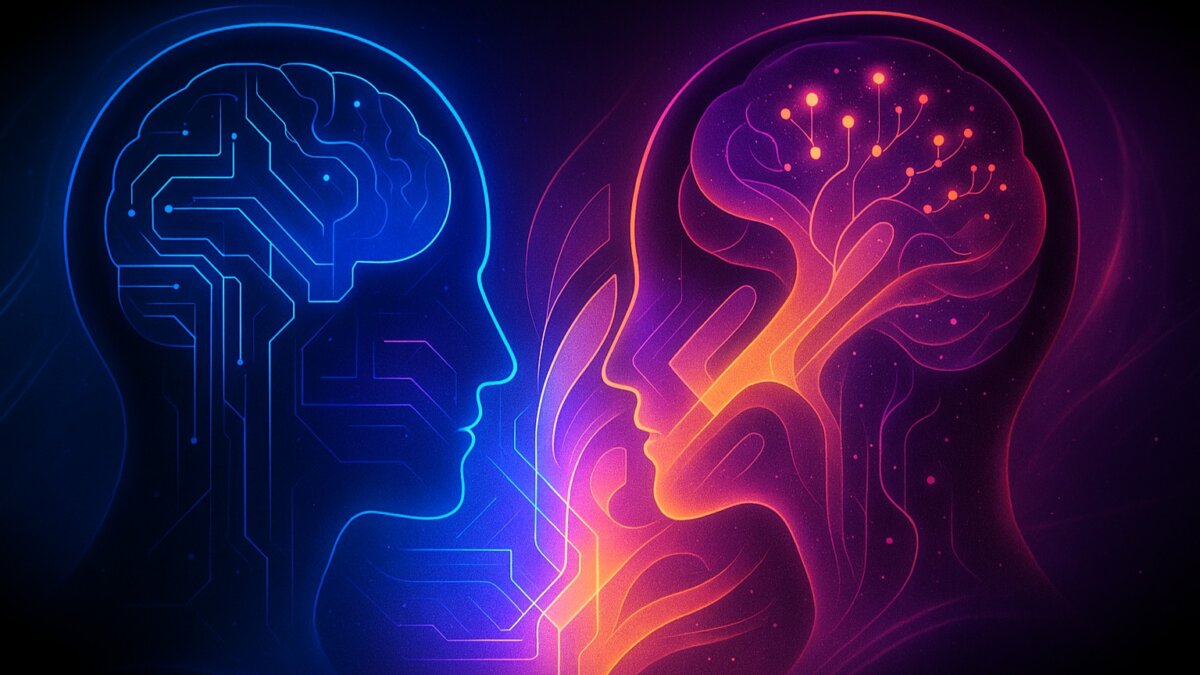
For us - Sascha and Sarah - an additional level is added: Neurodiversityt, which does not make our cooperation more difficult, but makes it possible in the first place.
We have different competencies, different perceptions and different ways of thinking.
But it is precisely these differences that result in an overall system that is stable, productive and generates creative content that is technically clean, psychologically deep and aesthetically clear.
In this extended article, we show not only how we work, but also why we work in this way – and how our life paths, our diagnoses and our highly gifted thinking styles complement each other.
1. Two biographical pathways – a common thinking architecture
1.1 Sascha’s background – understanding systems before they can be explained
At an early age, Sascha had the urge to understand things that others simply used.
While others played with toys, he wanted to know:
- How does it work?
- Why does it work?
- What happens if you change it?
- What are the rules behind it?
This early technical understanding was not learned.
It was intuitive – a kind of ‘inner model’ that forms automatically as soon as Sascha sees a system.
Whether computers, radios, consoles, networks or plug-in systems:
He does not analyze consciously. His brain disassembled, ordered, connected.
This cognitive structure persisted and shaped everything:
- Music production (understand signaling pathways)
- Synthesizer programming (parameter logic)
- Podcast planning (recognize dramaturgy)
- Technology development (optimization instead of chaos)
- Organization of digital work environments (folder-based architecture)
His giftedness was diagnosed late – as in many adults who are efficient but open to irritation.
It is only in retrospect that it becomes clear how strongly this way of thinking has influenced his life.
1.2 Sarah's background – Understanding the inner world before explaining it
Sarah is the counterpart, but not in the sense of ‘different’ – but in the sense of complementary.
Even as a child, she showed abilities that were unusually deep:
- She could clearly identify feelings.
- She understood the relationship between body and psyche.
- She recognized moods before anyone talked about it.
- She saw details that others have completely overlooked.
She developed an early sense of meaning:
Why we react, how we react.
Why do certain situations create stress?
How emotions manifest in the body.
How to find words that describe something exactly.
This kind of giftedness does not manifest itself in technical constructions, but in Psychological precision, visual perception and Linguistic subtlety.
Theirs too ADHD-Diagnosis came late, which is typical for women – the inattentive variant is often interpreted as ‘sensitivity’ or ‘daydreaming’, not as a neurological stimulus processing disorder.
2. How our talents differ – and why this is important
High talent can manifest itself in many forms.
With us, this results in two completely different thinking profiles.
2.1 Sascha – The systemic high performer
His thinking is:
- fast
- structured
- logical
- digital
- networked
- strategically
- detail-oriented
If Sasha understands a subject, then in his mechanics.
He sees the skeleton, not the skin.
Therefore, he can:
- Analyze technical problems immediately
- Building Music Structures Logically
- Combine parameters of synthesizers intuitively
- Optimize complex workflows
- Designing long-term content strategies
- Identify dependencies between systems
He thinks like an engineer, whether it's music, technology, podcasts or organisation.
2.2 Sarah – The introspective high performer
Your thinking is:
- atmospheric
- analytically
- symbolic
- visually
- psychologically
- Language sensitive
- context-based
If Sarah understands a subject, then in his meaning.
She sees the emotion, not just the structure.
Therefore, it can:
- Precisely naming psychological patterns
- Explaining medical relationships
- Describe visual atmospheres
- Making complex emotional processes understandable
- formulate clear, differentiated texts
- Identifying Mood in Music
- Intuitively perfecting image compositions
Their thinking is more like that of an analyst, an author, or a psychological researcher.
3. Two ADHD profiles that complement rather than hinder each other
ADHD does not mean ‘lack of attention’.
It means Deviating stimulus processing.
And these discrepancies affect us both – but differently.
3.1 Sascha – ADHD as a system disturbance and system booster
Its ADHD profile leads to:
- extreme irritability
- High speed of thought
- Overload in chaos
- hyperfocus in case of interest
- impulsive decisions
- severe emotional rashes in case of system errors
- The need for a technical and organisational structure
His brain works like a high-performance computer without a firewall:
Everything's coming in.
That's why Sascha needs:
- clear routines
- fixed processes
- Technical support
- Systems of order
- Predictable structures
When these structures are in place, he is extremely productive.
If they are missing, the system breaks down.
3.2 Sarah – ADHD as stimulus sensitivity and deep processing
The symptoms of ADHD can be seen in:
- strong deflectability
- internal unrest
- Physical overload
- High sensitivity to noise, light and mood
- deep pondering
- sensory overload
- Withdrawal as a protection mechanism
Your brain processes stimuli not too quickly – but too deeply.
It no longer perceives, but different:
- What is ‘a sound’ to others is a physical feeling to them.
- What is ‘a mood’ for others is a clear emotional state for them.
This type of ADHD is invisible – but intense.
4. How we work together in practice – detailed examples
4.1 Music – Structure meets feeling
Sarah:
Feeling, mood, symbolism, text, atmospheres, visual metaphors.
Sascha:
Technique, arrangement, sound design, mixing, mastering, workflow.
Example:
Sarah describes a mood like:
‘A sound that feels like a thought that can no longer be grasped.’
Sascha implements this:
- Filter modulation
- Changes in saturation
- Delay diffusion
- Reduced heights
- Halls with a lot of pre-delay
The interplay creates songs that are emotionally narrative and technically precise.
4.2 Texts - Structure meets psychological accuracy
Sascha Created:
- Classifications
- Thematic corridors
- logical sequences
- clear sections
- Structural dynamics
Sarah Delivers:
- psychological depth
- Examples of Real Dynamics
- precise language formulations
- Medical clarity
- Emotions that are understandable
This is how texts are created that:
- understandable
- well-founded
- non-judgmental
- clear
- complex
- but are accessible
4.3 Image design – symbolism meets technology
Sarah:
- conceives the image
- chooses colors, mood, emotion
- Describes light and symbolism
- formulates AI prompts that are extremely precise
Sascha:
- Optimizes the technology
- chooses resolution, contrast, format
- Edited images by
- integrate it meaningfully into the website or social media
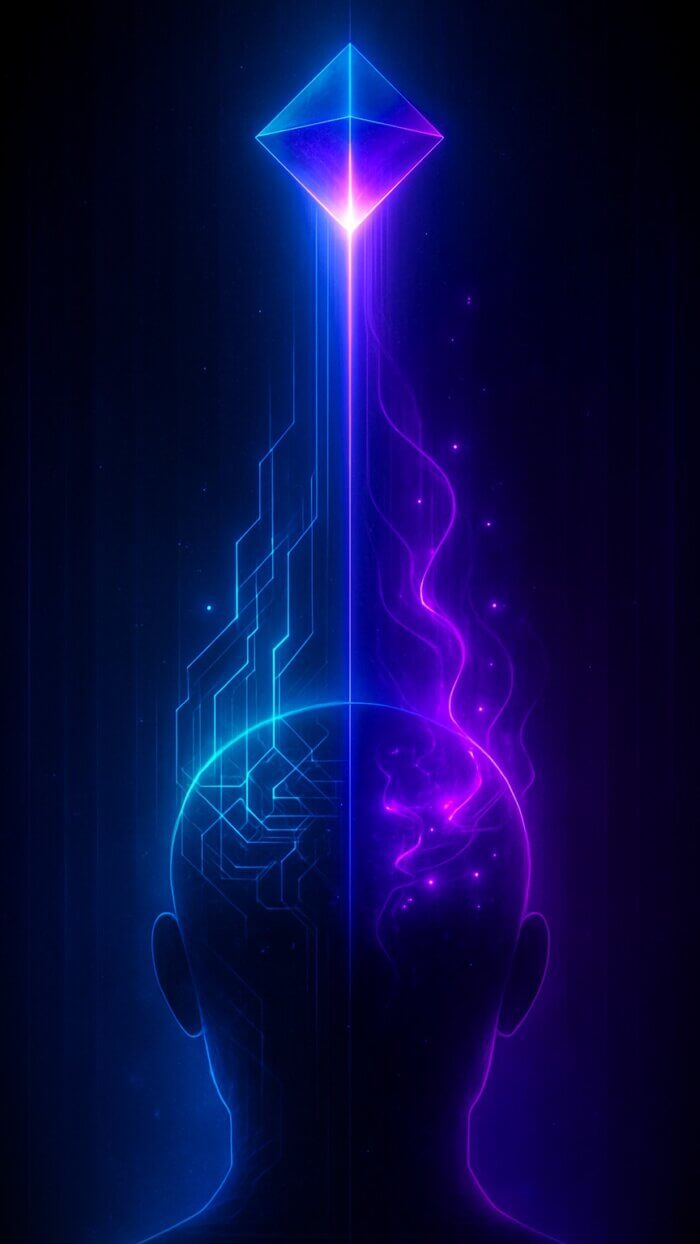
This creates visuals that look consistent, whether it's 16:9 covers or 9:16 reels.
5. Psychological basis: Why this duo works
5.1 Different stimulus profiles, same motivation
Sasha thinks quickly.
Sarah thinks deeply.
Both complement each other.
No one replaces the other.
5.2 Same diagnosis, different problems - perfect balance
When Sascha is overloaded with external stimuli, Sarah analyzes the situation.
When Sarah is overwhelmed by inner stimuli, Sascha structures the environment.
5.3 Common value: Clarity without superficiality
Sasha brings clarity.
Sarah brings depth.
This results in content that:
- technologically
- content
- emotionally
- and visually
are coherent.
6. What happens in the end
From these differences arises a Rare overall system:
- Music with technical superiority and Emotional texture
- Texts that are psychologically precise and are structured
- Visuals that are atmospheric and are technically optimized
- Podcasts that are clearly structured and are deeply reflected
- Blog posts that can carry long, understandable, complex content
We are not a typical team.
We are an Neurodiverse duo, which shares a common, unique thinking architecture.
📚 Recommended books
- AD(H)S and giftedness: Learning ‑ and Behavioral Problems Despite High Intelligence in Children and Adolescents
Author: Helga Simchen
This book sheds light on the often overlooked link between ADHD and giftedness in children and adolescents, including implications for adults. It provides good insights into Mindset, distractibility and underachievement, Which directly addresses your issues. Amazon+2Amazon+2 - Between giftedness and ADHD. How does misdiagnosis occur and how can it be avoided?
Author: Bianca Lehner
This is about the problem of misdiagnosis in people with giftedness and ADHD. Very relevant if you write about diagnostic pathways and self-understanding. Amazon+1 - Ingenious, disturbed, bored? : ADHD, school and giftedness
Authors: Thilo Fitzner and Werner Stark
While this book is primarily aimed at the school context, it offers valuable perspectives on giftedness + ADHD + motivation – in particular how intelligent thinking can collide with low attention. Amazon - Highly sensitive: It's different, but still normal : Life between giftedness and overstimulation
Author: Birgit Trappmann
Even if the focus is not exclusively on ADHD, topics such as high sensitivity, overstimulation and giftedness are dealt with – exactly elements that play a major role in your creative work. Amazon - ADHD in adults – a life in extremes
Author: Mandy Roy
A practice book for adults with ADHD – topics: Everyday management, diagnosis, self-management. Ideal for your readers who deal with ADHD in their adult lives. Amazon - AD(H)S: The hidden power within us – The journey from chaos to self-acceptance
Author: Katharina Schön
This book sheds light on ADHD as a resource – not just as a limitation. Very appropriate for your positive view of neurodiversity. Amazon
Affiliate notice:
This post contains affiliate links. If you purchase via these links, we will receive a small commission – you will not incur any additional costs. Thank you for your support.
🧠 Glossary
ADHD (attention deficit/hyperactivity disorder)
A neurobiological attention and stimulus regulation disorder. In adults, it often manifests itself through distractibility, overstimulation, hyperfocus, impulsive behavior and difficulties in everyday organization. ADHD can be very different.
Neurodiversity
A collective term for natural differences in the functioning of human brains. These include ADHD, autism, giftedness, dyslexia, dyscalculia, and other neurocognitive peculiarities. Neurodiversity means ‘working differently’ instead of ‘being sick’.
giftedness
A clearly above-average cognitive potential, usually measurable via IQ tests (from about IQ 130). Giftedness manifests itself not only in speed, but in particular depth or interconnectedness of thought. Important: There are different types of giftedness (systemic, linguistic, visual, analytical, etc.).
System thinking
A way of thinking in which information is automatically linked to structures, processes or models. System thinkers recognize patterns and relationships very quickly. Typical of Sasha.
Introspective thinking
A form of giftedness that focuses on the inner world: Feelings, meanings, psychological processes, medical connections. Individuals with introspective talent recognize fine nuances and can accurately describe complex internal processes. Typical of Sarah.
Irritability
A condition in which the brain can filter external stimuli worse. Sounds, light, smells or conversations are perceived more intensively. People with ADHD are often irritable and need more structure to not overload.
Irritation sensitivity
A subtype of open-mindedness, in which particularly emotional or physical stimuli are experienced very intensively. Those affected react strongly to mood, warmth, volume, light or social signals. Typical of Sarah.
hyperfocus
A state of extreme concentration of interest. People with ADHD can work for hours without a break if a topic really captivates them – while they can hardly start everyday tasks.
Executive functions
Cognitive skills such as planning, working memory, organization, prioritization, impulse control, and task start. In ADHD, these functions are often limited.
Structuring
The process by which processes, routines and systems are created so that one's own thinking remains more stable. Sascha uses structural formation to compensate for his ADHD symptoms.
Intuitive analysis
An ability in which contexts are understood without conscious reflection. Instead of numbers or logic, intuitive analysis focuses on the emotional or atmospheric significance. Very typical of Sarah.
Neural patterns
Visual or mental structures that symbolize how brains process information. Often used in visuals to represent thought styles.
Cognitive empathy
The ability to logically understand other people’s thoughts, motives or behavioural patterns – without having a strong sense of their emotions. Often more pronounced with systemic giftedness (e.g. Sascha).
Emotional empathy
The ability to understand other people's feelings and experience them emotionally. Often more pronounced with introspective giftedness (e.g. Sarah).
Synthesizer programming
The technical process of creating and shaping electronic sounds. Requires logical and systemic thinking. A strength of Sascha.
Suno prompts / AI prompts
Text input used to control AI tools (such as Suno for music or Foooocus/Stability for images). The more precise the prompt, the better the result. Sarah is particularly strong in the atmospheric design of such prompts.
Creative duo
A collaboration in which two thinking styles are deliberately combined to create a common system – stronger than the sum of the individuals.
Symbolic imagery
A form of visualization in which abstract elements (light, color, form) carry meanings. Often used in your AI images.
Psychological precision
The ability to describe mental or emotional states clearly, differentiatedly and without exaggeration. A special strength of Sarah.
Structured creativity
The combination of free ideas and logical implementation. Many of your projects are created precisely through this mixture: Sarah develops atmosphere and meaning, Sascha builds a functioning system from it.
Discover more from LautFunk Podcast & Blog
Subscribe to get the latest posts sent to your email.

 English